London EICR Risk Index 2026: Borough Risk Factors, Landlord Duties and Electrical Safety Planning

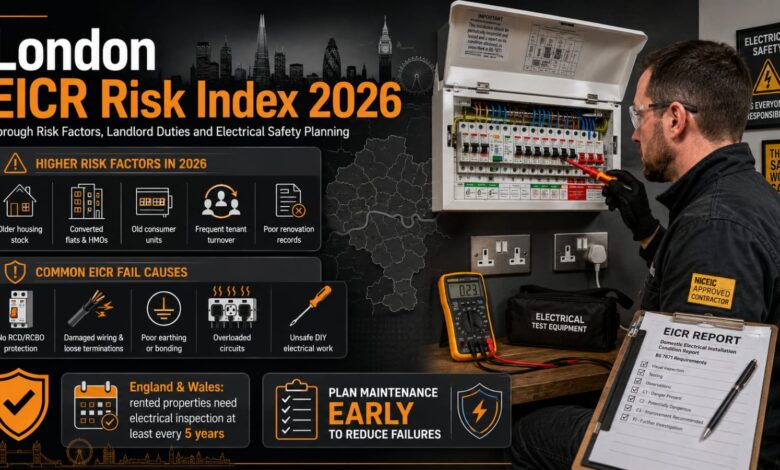
Summary: This guide explains why some London properties are more likely to receive unsatisfactory EICR reports, what landlords should monitor, and how electrical safety compliance applies across England and Wales.
Electrical safety is now a core property management issue for landlords, homeowners and managing agents across London. A rented flat may look clean, modern and well maintained, yet still contain ageing wiring, overloaded circuits, weak earthing, old accessories or a consumer unit that does not offer the protection expected in a modern installation. These problems often remain hidden until a full electrical inspection is carried out.
The phrase London EICR Risk Index 2026: Which London Boroughs Face the Highest Electrical Safety Failures? should be treated as a practical risk framework, not as a formal government ranking of London boroughs. At the time of writing, there is no single official borough-by-borough EICR failure league table that should be quoted as fact without supporting data. What can be assessed more reliably are the conditions that increase the chance of an unsatisfactory report: property age, conversion history, rental use, wiring condition, consumer unit protection and the quality of previous electrical work.
This distinction matters for SEO and for accuracy. Some areas of London include more older housing stock, HMOs, converted buildings and high-turnover rental properties. Those characteristics can increase the likelihood of electrical deterioration, but they do not automatically make every property in that borough unsafe. A well-maintained Victorian house with modern wiring can be safer than a newer property with poor workmanship or undocumented alterations.
Why EICR Failure Risk Is Increasing in London
London homes are using more electricity than older installations were originally designed to support. Tenants and families now rely on multiple chargers, laptops, kitchen appliances, tumble dryers, entertainment systems, electric heating equipment and sometimes EV charging points. In properties where the wiring has not been upgraded properly, this additional demand can reveal weaknesses in circuits, protective devices and accessories.
The capital also has a large amount of mixed-age housing. Many buildings have been extended, converted or refurbished in stages. A property may have a modern kitchen circuit, older lighting circuits, added sockets in bedrooms, a replaced consumer unit and historic wiring still hidden behind walls. Without clear certificates and proper testing, landlords may not know whether the installation is truly safe for continued use.
For landlords, the risk is both practical and legal. In England, landlords must ensure rented electrical installations are inspected and tested by a qualified person at least every five years. In Wales, rented homes must also have electrical installations tested at least every five years unless the previous report requires a shorter interval. Where defects are identified, remedial action must be taken within the required timeframe.
What an EICR Actually Assesses
An Electrical Installation Condition Report checks the fixed electrical installation of a property. It does not simply look at whether the lights work. The electrician inspects and tests circuits, protective devices, earthing, bonding, sockets, switches, lighting points, cable condition and consumer unit safety. The purpose is to decide whether the installation is safe for continued use.
A report may be marked satisfactory or unsatisfactory. A satisfactory result means no dangerous or potentially dangerous observations have been recorded. An unsatisfactory result usually means the report includes C1, C2 or FI observations, which require immediate action, urgent remedial work or further investigation.
Common Reasons London Properties Fail EICR Inspections
- Exposed live parts or damaged accessories
- Deteriorated wiring insulation
- Lack of suitable RCD or RCBO protection
- Loose terminations inside accessories or consumer units
- Poor earthing or bonding arrangements
- Unsafe DIY electrical additions
- Overloaded circuits and inadequate socket capacity
- Incorrect circuit identification or poor labelling
- Signs of overheating, scorching or arcing
- Consumer units that are damaged, outdated or poorly installed
- Previous electrical work with no supporting certification
These issues are often found together. For example, a converted flat may have poor circuit labelling, older wiring, limited socket capacity and accessories that have been damaged through long-term tenant use. An older family home may have a mix of modern and historic wiring, making testing more important before any assumption is made about safety.
Why Borough Risk Depends on Property Profile, Not Just Location
It is tempting to describe EICR risk by borough name alone, but that can be misleading. Electrical risk is shaped by the property itself. Boroughs with more older private rentals, HMOs, converted flats or properties with repeated extensions may naturally show more inspection problems, but the individual installation must still be assessed professionally.
A useful risk index should consider the following property factors:
| Risk Factor | Why It Increases Risk | Typical EICR Concern |
| Older housing stock | Wiring may have aged or been modified many times. | Brittle insulation, poor bonding, old circuits |
| Converted flats | Installations may have been divided or altered from the original layout. | Unclear circuits, shared supplies, overloaded boards |
| HMOs | Higher occupancy often creates greater electrical demand. | Socket overload, accessory damage, fire risk |
| Old consumer units | Older boards may lack modern protective devices. | No RCD/RCBO protection, poor fault clearance |
| Frequent tenant turnover | Wear and damage can increase between inspections. | Broken sockets, loose fittings, damaged accessories |
| Poor renovation records | Previous works may not have been certified or tested. | Unsafe alterations, hidden junctions, wrong cable routes |
Older Wiring and Historic Electrical Alterations
Many London homes have been changed repeatedly. Kitchens have been moved, lofts converted, rear extensions added and extra sockets installed to meet modern expectations. Each alteration may have been completed by a different contractor, at a different time, and to a different standard. Where documentation is missing, an EICR becomes especially important.
Older wiring can create several risks. Cable insulation may become brittle, junctions may be hidden, circuit routes may be unclear and protective devices may not match the way the property is now used. Even when everything appears to function, testing may reveal defects that are not visible during day-to-day use.
Consumer Units, RCD Protection and Modern Safety Expectations
Consumer units are one of the most common areas where EICR observations are made. Modern electrical safety depends heavily on correctly selected protective devices. RCDs and RCBOs can disconnect a circuit quickly when certain faults occur, helping to reduce shock risk and improve protection for users.
An old consumer unit does not automatically mean a property will fail. However, damaged enclosures, missing covers, poor labelling, loose terminations, absence of suitable RCD protection and signs of overheating can all lead to serious observations. Landlords should treat consumer unit condition as part of ongoing maintenance rather than waiting until the next inspection deadline.
How EICR Codes Affect the Final Result
EICR codes explain the seriousness of each observation. C1 means danger is present and immediate action is required. C2 means the issue is potentially dangerous and urgent remedial work is needed. FI means further investigation is required because the electrician cannot confirm safety without more testing. C3 means improvement is recommended, but it does not normally make the report unsatisfactory on its own.
Landlords should not treat the report as a formality. If a report is unsatisfactory, it must be acted upon. Keeping a copy of the report is not enough if dangerous or potentially dangerous defects remain unresolved.
Landlord Duties in England and Wales
Electrical safety duties for rented homes are particularly important. In England, landlords must have rented electrical installations inspected and tested by a qualified person at least every five years. Copies of the report must be provided to tenants and local authorities where required. If the report identifies C1, C2 or FI observations, remedial work or investigation must be completed within the required period.
In Wales, the Renting Homes framework and fitness for human habitation requirements also place clear responsibilities on landlords. Electrical installations in rented dwellings must be tested at least every five years unless the previous report sets a shorter interval. Where a shorter interval is stated, that shorter date should be followed.
Landlords should keep organised records, including EICR reports, remedial certificates, invoices, tenant communications and any evidence of follow-up works. Good record keeping helps demonstrate that the property is being managed responsibly.
Which Properties Deserve Early Attention in 2026?
Some properties should be prioritised before inspection deadlines become urgent. These include HMOs, older private rentals, converted flats, homes with repeated tenant complaints, properties with old fuse boards, buildings with undocumented electrical work and homes where circuits trip frequently.
Landlords should also pay close attention to properties where tenants report burning smells, flickering lights, buzzing sockets, warm accessories, damaged switches, partial power loss or repeated tripping. These symptoms should be investigated promptly, not left until the next scheduled EICR.
Reducing the Risk of an Unsatisfactory EICR
The best way to reduce EICR failure risk is through planned maintenance. A property that is inspected, repaired and documented regularly is less likely to produce expensive surprises. Preventative work is usually less disruptive than emergency remedial repairs after a failed report.
- Review all EICR expiry dates well in advance.
- Inspect accessories between tenancies.
- Repair damaged sockets, switches and light fittings promptly.
- Avoid unqualified electrical work.
- Keep certificates for new circuits, consumer units and alterations.
- Check earthing and bonding where older installations are present.
- Plan rewiring where wiring is clearly outdated or repeatedly problematic.
- Respond quickly to tenant electrical complaints.
- Budget for remedial works before the certificate deadline.
Understanding EICR Cost Factors in London
The price of an EICR depends on the size and complexity of the installation. A small flat with one consumer unit and a limited number of circuits will usually be quicker to test than a large HMO, commercial premises or property with several distribution boards.
Cost can be affected by the number of circuits, number of consumer units, access, parking, property age, urgency, whether the installation is labelled clearly and whether further investigation is required. Landlords should avoid choosing an inspection based only on the lowest price. A rushed report can miss important defects or create compliance problems later.
Why Electrical Fault Finding May Be Needed
An EICR can identify that a problem exists, but further fault finding may be needed to locate the exact cause. For example, an FI code may mean the electrician needs to investigate a circuit more deeply before confirming whether it is safe.
This article is also very useful for landlords and homeowners who want to understand the diagnostic side of electrical safety: What Tools Are Used for Electrical Fault Finding? It explains the specialist equipment and methods used to identify insulation problems, overheating risks, circuit faults and unsafe wiring conditions.
Choosing the Right Electrical Professional
A reliable Electrician in London should understand inspection and testing, BS 7671, domestic landlord compliance, EICR coding and the electrical challenges found in older London properties. The quality of the report matters because landlords and homeowners need clear explanations, not just a list of codes.
When choosing an electrician, look for suitable qualifications, inspection and testing experience, professional insurance, transparent pricing, clear written reports and the ability to explain remedial options. A good electrician should help the property owner understand what has failed, why it matters and what action is needed next.
Planning for 2026 and Beyond
Electrical safety expectations are unlikely to become less important. Tenants are more aware of safety documentation, local authorities continue to enforce landlord responsibilities, and modern living continues to increase electrical demand. Landlords should therefore take a planned approach rather than waiting until a report expires.
A sensible 2026 electrical safety plan should include reviewing certificate expiry dates, prioritising high-risk properties, budgeting for remedial works, checking previous electrical certificates, inspecting consumer units between tenancies and responding promptly to tenant complaints. Where a property has repeatedly failed inspections or required frequent repairs, a more substantial upgrade may be more cost-effective than repeated patch repairs.
Final Thoughts
EICR risk in London is not determined by borough name alone. It is shaped by the age, condition, use and maintenance history of the property. Older homes, converted flats, HMOs and properties with outdated consumer units may be more likely to show defects, but any installation can fail if it has been poorly installed, damaged or neglected.
For landlords in England and Wales, EICR compliance is both a legal responsibility and a practical safety measure. For homeowners and property managers, electrical inspection offers a clearer understanding of risk before faults become dangerous. Regular testing, accurate reports, prompt remedial works and careful documentation remain the most effective way to reduce EICR failures and protect occupants in 2026 and beyond.