Volvo Ailsa: The Iconic Front-Engined Double-Decker That Transformed Public Transport
Exploring the History, Design, and Legacy of the Revolutionary Volvo Ailsa B55

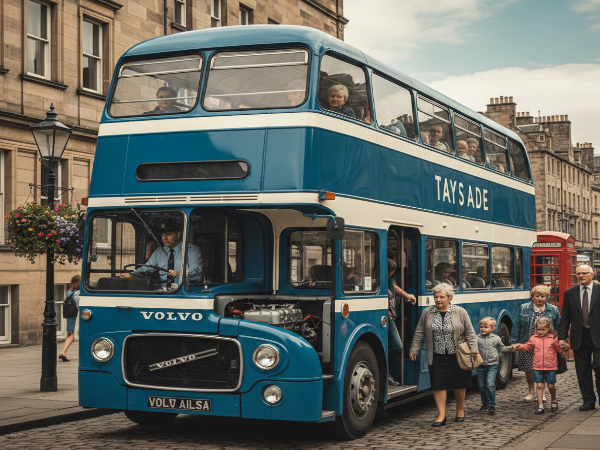
The Volvo Ailsa B55 occupies a special place in the history of public transportation. Unlike conventional double-decker buses of its time, the Volvo Ailsa integrated a front-mounted engine with a front entrance, which was both an engineering challenge and a breakthrough in urban bus design. Produced from 1974 to 1985, it served as a bridge between traditional multi-operator buses and modern one-person-operated vehicles. Its innovative design made it ideal for city transport networks where efficiency, reliability, and passenger safety were paramount.
History of the Volvo Ailsa
The story of the Volvo Ailsa begins in Scotland, where Ailsa Bus Ltd, a subsidiary of Volvo, sought to develop a double-decker bus capable of meeting the changing demands of urban transportation in the 1970s. The first prototype was unveiled at the 1973 Scottish Motor Show, showcasing a bold new concept in bus design. By 1974, full-scale production commenced at the Irvine plant, with the bus quickly gaining attention from Scottish and UK transport authorities.
Operators were drawn to its driver-only operation capability, allowing buses to run efficiently with fewer staff. Unlike other buses that required conductors, the Volvo Ailsa empowered a single driver to manage boarding, fare collection, and vehicle operation. This innovation dramatically reduced operational costs while maintaining service quality.
Over its 11-year production run, over 1,000 units were manufactured, making the Volvo Ailsa a familiar sight on streets across Scotland, Northern England, and other parts of the UK. The bus’s success also reflected Volvo’s dedication to combining robust engineering, practical design, and operational efficiency.
Design and Engineering Features
Front-Engine Layout
The most striking feature of the Volvo Ailsa was its front-mounted engine, positioned alongside the front entrance. This layout was rare for double-decker buses of the time, which typically had rear or mid-mounted engines. The front-engine placement offered several advantages:
Easier maintenance access for mechanics.
Better weight distribution, improving stability.
Enhanced driver visibility and operational control.
The engine itself was a Volvo TD70 turbocharged diesel, with 6.7 liters of capacity. It was known for its durability, fuel efficiency, and reliability, even under the stress of urban routes.
Chassis and Suspension
The Volvo Ailsa B55 utilized a beam axle chassis paired with leaf spring suspension, providing both strength and comfort. The chassis was designed to accommodate a front entrance alongside the engine, a feature that set it apart from competitors. This allowed the bus to remain compact in size yet spacious for passengers, with room for up to 80 individuals.
Transmission and Driver Controls
Equipped with a semi-automatic Self-Changing Gears transmission, later supplemented by optional Voith automatic gearboxes, the Volvo Ailsa was easy to operate, even for drivers new to double-decker buses. This feature reduced driver fatigue and allowed smoother rides, which were particularly beneficial during peak city traffic.
Passenger Flow and Comfort
The unique combination of a front entrance with a front engine allowed efficient boarding and alighting, improving passenger flow significantly. Seating was arranged to maximize comfort while maintaining capacity. The bus also incorporated robust handrails and wide steps, ensuring safe movement for passengers, including the elderly and children.
Variants of the Volvo Ailsa
Mark I
The Mark I was the initial production model introduced in 1974. It included all the signature features of the Ailsa B55 and served as the standard for later models.
Mark II
The Mark II featured improvements in engine efficiency, suspension, and driver ergonomics. It was slightly lighter, which contributed to reduced fuel consumption.
Mark III
By the 1980s, the Mark III incorporated minor cosmetic and technical upgrades, including better seating layouts, updated transmission options, and noise-reduction enhancements. Eventually, the Ailsa name was dropped in favor of Volvo’s standard branding.
Operational History
The Volvo Ailsa became a favorite with multiple transport operators:
Tayside Regional Council, Scotland
Strathclyde Passenger Transport Executive
West Midlands PTE
South Yorkshire PTE
The bus was known for its reliability, particularly in challenging weather conditions across Scotland. Operators appreciated the low maintenance costs and the ability to run driver-only services, which allowed better allocation of resources.
Advantages of the Volvo Ailsa
Driver-only operation: Reduced labor costs and improved efficiency.
Front-engine layout: Easier maintenance and improved safety.
Efficient passenger flow: Faster boarding and alighting reduced stop times.
Durable construction: Long service life with minimal downtime.
Operational flexibility: Suitable for both city and suburban routes.
Legacy of the Volvo Ailsa
Even decades after production ended in 1985, the Volvo Ailsa remains a symbol of engineering ingenuity. It influenced later bus designs, especially in driver-only operation layouts and front-engine configurations. Many transport museums and enthusiast groups preserve Volvo Ailsas, recognizing their role in transforming British urban transportation.
The bus also represents Volvo’s commitment to practical, durable, and innovative engineering, ensuring that even today, the Volvo Ailsa is remembered not just as a bus, but as a milestone in public transport history.
Conclusion
The Volvo Ailsa B55 is more than a bus; it is a landmark in public transportation innovation. Its unique front-engine design, driver-only operation capability, and robust engineering set new standards in efficiency and practicality. Favored by operators across Scotland and the UK, the Volvo Ailsa demonstrated how thoughtful engineering could transform urban mobility, making it one of the most significant buses of its era. Its legacy endures, reminding us that innovation in transportation can have a lasting impact on cities, communities, and passengers.