There is a strange asymmetry in how local businesses allocate marketing attention. The website (expensive, slow to change, requiring a developer) gets most of it. The Google Business Profile (free, editable in ninety seconds, and the thing customers actually see first) gets set up once and never touched again.
Digital Applied’s 2026 data puts the scale of the neglect at 56% of profiles not optimised, missing photographs, categories, or descriptions. That is more than half the competitive field leaving the free thing undone.
What the profile is actually worth
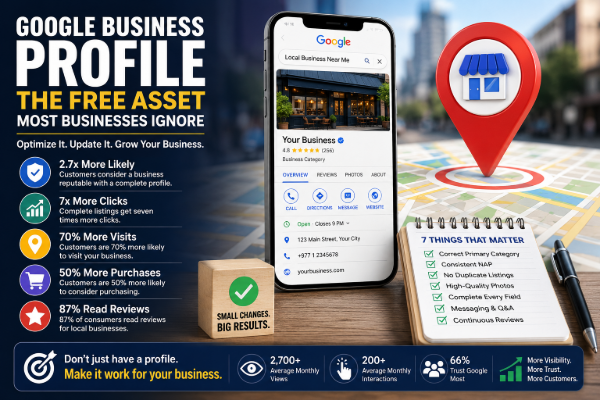
Google’s own documentation quantifies the effect of completeness. Customers are 2.7 times more likely to consider a business reputable when they find a complete Business Profile on Search and Maps. They are 70% more likely to visit and 50% more likely to consider purchasing.
Publer’s analysis found that listings with accurate and complete information receive seven times more clicks than those without. Birdeye’s research puts average monthly interactions on a verified profile at around 200; Digital Applied puts average monthly views for an optimised profile at roughly 2,700.
For a large number of small businesses, that is more visibility than their website generates in the same period, from an asset that costs nothing and takes a couple of hours to fix properly.
The trust data is more pointed still. When people research local businesses, they trust Google most (66%), then Google Maps (45%), then the business’s own website (36%). The surface receiving most of the marketing budget is the least trusted of the three, and it is the only one most businesses actively manage.
The seven things that actually matter
- The primary category. This is the strongest single lever and it is frequently set wrong.
Google uses the primary category to determine which searches you are eligible to appear in at all. A business categorised as “Restaurant” competes in a different pool from one categorised as “Nepalese Restaurant” or “Vegetarian Restaurant.” Broader is not better. It is more competitive and less relevant.
Set the primary category as specifically as is honestly accurate, then add secondary categories for the other things you genuinely do. Check what your best-performing competitors use; the category list is not always intuitive and there are frequently options you did not know existed.
- One canonical name, address and phone. Google’s local algorithm relies on consistency to establish that scattered mentions across the web refer to one entity. Every variation weakens that signal.
The classic failure: the website says “Kathmandu-32,” the Facebook page says “near Bhatbhateni, Maharajgunj,” and the profile says something else again. This is endemic in markets without a consumer-facing postcode system, where addresses are expressed as ward numbers, tole names and landmarks, and the same business writes its address three different ways without noticing.
Pick one exact format. Write it in a document. Use that string everywhere, character for character, including how you abbreviate. It costs nothing and it is frequently the highest-value local work available.
- Duplicate listings. Duplicates get created when a business is added by a customer, an aggregator, or a former employee, and two listings for one business suppress each other, splitting reviews, splitting signals, and confusing the algorithm about which is real.
Search your business name. Search your address. Search your phone number. Claim everything you find, then merge or remove the duplicates. This frequently produces the fastest visible improvement of anything available in local search.
- Photographs, in volume. Not three stock images. Twenty or more real photographs: the exterior from the street so people can find the door, the interior, the team, the product, the work in progress. Update them. Profiles with active recent photos outperform static ones, and the exterior shot in particular reduces the friction of actually arriving.
- Every field completed. Hours including holiday hours, attributes, services with descriptions, the business description, the products list, the appointment link. Each completed field is both a ranking signal and a reason for someone to choose you over a competitor whose profile is blank.
- Messaging and the Q&A section. Around 45% of businesses receive appointment requests through their profile, and over half of consumers will call directly from it. The Q&A section is public and anyone can post there, including your competitors. Seed it yourself with the questions you actually get asked, and answer them. An unmonitored Q&A section is a liability.
- Reviews, continuously. Covered properly elsewhere, but the headline: 87% of consumers read reviews for local businesses, and BrightLocal found that improving from 3.5 to 3.7 stars produced conversion growth of nearly 120%, the largest jump from any rating change. Star ratings also govern attention inside the local pack: five-star listings capture around 69% of attention, four-star 59%, three-star 44%.
Five ways businesses lose profile visibility without realising
Beyond simple neglect, there are specific failure modes that actively suppress an otherwise well-maintained profile. All five are common and all five are reversible.
Keyword stuffing the business name. Adding descriptive terms to the name field, such as “Sharma Dental Clinic Best Dentist Pokhara”, violates Google’s naming guidelines. It occasionally works briefly and it exposes the listing to suspension, which for a local business is close to an extinction event. It is also reportable by competitors, and competitors report it.
A service area set wrong. Businesses that serve customers at their own location should show an address. Businesses that travel to customers should be configured as a service area business and hide the address. Getting this backwards, or setting a service radius that covers half the country, dilutes relevance rather than extending reach.
Hours that are wrong, especially around holidays. Google surfaces “open now” prominently, and a listing showing closed during business hours simply does not get the call. Special hours for Dashain, Tihar and public holidays have to be set explicitly or the regular hours apply.
Suggested edits accepted silently. Customers and Google’s own systems can propose changes to your hours, address, category and attributes, and these can go live without your approval. A profile nobody checks can drift into inaccuracy without anyone touching it. This alone justifies the weekly check.
Review gating. Sending happy customers to Google and unhappy ones to a private feedback form breaches Google’s policies and produces a rating profile that reads as suspicious. A flawless five with no critical reviews is less credible to a reader than a 4.6 with a few threes.
Why the AI shift makes this more important, not less
There is a live change here worth understanding, because it inverts the usual advice.
Roughly 40-43% of local business queries now trigger a Google AI Overview, and those results cut clicks reaching individual business websites by an estimated 31%.
That sounds like bad news, and for the website it is. But the same dataset shows that 67% of AI Overviews for local queries reference Google Business Profile data directly, and optimised profiles are recording 2.4x more profile views from AI-generated local recommendations.
So AI Overviews are moving value from the local business website to the local business profile. Clicks to the site fall; interactions with the profile rise.
For a local business, that is a reason to invert the standard budget priority. The asset gaining leverage is the free one, and the businesses treating it as a set-and-forget item are losing ground on the surface that is growing while defending the one that is shrinking.
It also creates a measurement trap. If your reporting stops at website sessions, this shift looks like decline. Profile views, calls, direction requests and messages have to be in the report or you will draw exactly the wrong conclusion.
The maintenance habit
The profile is not a project. The businesses that get results treat it as an operational routine.
Weekly: check for new reviews and respond to all of them. Check the Q&A section for new questions. Check for suggested edits Google has applied: customers and the algorithm can change your hours and attributes without asking you.
Monthly: add photographs. Review the insights panel for which search terms are surfacing your profile, which is genuinely useful keyword data that most businesses never look at.
Quarterly: re-check for duplicate listings, verify NAP consistency across the top directories that mention you, and confirm your categories still describe what you do.
Perhaps twenty minutes a week. Against an asset generating hundreds of interactions a month, that is the best return on time available in local marketing.
Where it fits in the wider picture
None of this replaces the website. It sequences ahead of it.
The pattern that works for local businesses is: fix the profile first because it is free and it is where the clicks are, fix the existing pages on the site second because that is the highest-return work on it, and only then commission anything new.
Most providers propose the reverse, because a content calendar is a legible deliverable and “we are going to fix your profile and rewrite six pages” is not. When evaluating a provider, whether that is an seo expert nepal businesses recommend or anyone else, the useful filter is whether their first proposal for a single-location business is about the profile or about blog posts. Local search rewards the profile. A proposal leading with content volume has not read the data.
This is also why practitioners working in smaller markets tend to weigh local work more heavily than the international playbooks suggest. An seo expert pokhara or in any market where address formats are inconsistent and duplicate listings are endemic will typically find more upside in a week of profile and citation work than in a quarter of content production. The conditions on the ground determine the priority, not the generic best-practice ordering.
The summary
The Google Business Profile is free, it is the first thing local customers see, complete profiles get seven times the clicks of incomplete ones, and 56% of profiles are incomplete.
Google’s own data: complete profiles make customers 2.7x more likely to consider you reputable, 70% more likely to visit, 50% more likely to consider buying. Two-thirds of local AI Overviews cite profile data directly, and profile views from AI recommendations are up 2.4x.
Set the category correctly, force one address format, kill the duplicates, add twenty photographs, fill every field, and check it weekly.
It costs nothing, most of your competitors have not done it, and it is becoming more valuable rather than less.