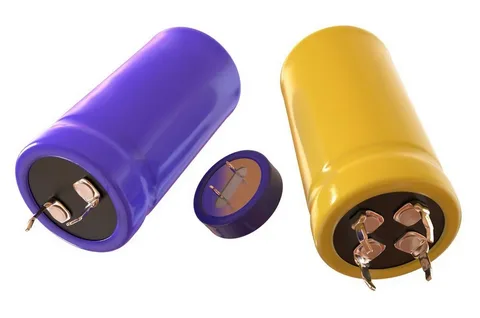
The debate around energy storage in audio has been running for a long time. Audiophiles and car audio builders have experimented with dedicated battery banks, oversized alternators, isolation setups, and every variation in between — all chasing the same goal: giving the amplifier a cleaner, more stable supply so the music comes through the way it was meant to. What has changed in recent years is that supercapacitors for audio systems have matured from an industrial component into something genuinely practical for audio applications, and the comparison with batteries is no longer one-sided.
This is not an argument that supercapacitors replace batteries in every situation. They do not. But understanding what each technology actually does — and where each one falls short — is the only way to make a decision that holds up in practice rather than on paper.
How Each Technology Stores and Delivers Energy
Batteries store energy through electrochemical reactions. The process is dense and efficient for long-duration output, but it is inherently slow at the physics level. When an amplifier demands a sudden current spike, the battery’s chemistry has to respond, and that response has a measurable lag. In most household listening environments this is masked by the power supply design, but in high-demand audio systems — particularly anything with a serious subwoofer stage or high-power Class AB amplification — the limitation shows up as sag, compression, and reduced transient impact.
Supercapacitors store energy electrostatically rather than chemically. There is no reaction to complete, no chemical intermediary between the stored charge and the output terminal. When the amplifier calls for current, the supercapacitor delivers it in milliseconds, with internal resistance low enough that the voltage rail barely moves. This is the core advantage, and it is a physical one rather than a marketing claim.
Head to Head: Supercapacitor vs Battery for Audio
| Parameter | Supercapacitor | Battery |
| Discharge speed | Milliseconds — ideal for transients | Seconds to minutes |
| ESR (internal resistance) | Very low (sub-milliohm range) | Higher, increases with age |
| Cycle life | 500,000 to 1,000,000+ cycles | 300 to 1,500 cycles typically |
| Energy density | Low — not suited for long backup | High — good for sustained output |
| Response to peak demand | Excellent | Moderate to poor |
| Maintenance | None | Requires monitoring, periodic replacement |
| Temperature sensitivity | Low | Significant — degrades in heat and cold |
| Weight | Light | Heavy, especially lead-acid |
| Risk of failure modes | Minimal | Leakage, sulfation, thermal runaway (lithium) |
The table makes the trade-off clear. Batteries win on energy density — if you need to run an audio system for an hour off-grid with no charging source, a battery is the only tool for that job. But for every metric that affects real-time audio performance — response speed, consistency under dynamic load, long-term reliability — the supercapacitor holds the advantage.
Where Supercapacitors for Audio Systems Make the Most Sense
The applications where supercapacitors genuinely outperform batteries fall into a few clear categories.
High-power amplifier stages are the most obvious case. Any amplifier drawing significant peak current — whether in a home system running from a linear supply or a car audio installation pulling from the vehicle’s electrical system — benefits from local energy storage that can respond faster than the main supply. The amplifier sees stable voltage during transients, and the dynamic headroom of the system increases without any change to the amplifier itself.
Systems with multiple amplifier channels compound the demand problem because peaks from different channels can overlap. A multichannel setup with separate amplifiers for highs, mids, and bass can create simultaneous current spikes across all stages. Supercapacitors placed at each amplifier’s supply connection buffer these independently, preventing one channel’s demand from pulling down the supply for the others.
Installations where battery weight or chemistry is a concern — particularly in custom car audio builds, portable systems, or any application where a lithium battery would introduce safety complexity — benefit from the simpler, safer profile of a supercapacitor. There is no thermal runaway risk, no requirement for a battery management system, and no degradation curve to manage over time.
The Hybrid Approach: When Both Make Sense Together
There is a practical middle ground that some serious installations use — a battery handling the baseline sustained supply, and a supercapacitor handling the peak transient demand. The battery keeps the voltage from falling over longer listening sessions or when the charging source is unavailable, while the supercapacitor sits between the battery and the amplifier to handle the millisecond-level spikes the battery cannot respond to quickly enough.
This combination works particularly well in car audio builds where the alternator and main battery handle sustained load, a secondary battery isolates the audio system from the engine start circuit, and supercapacitor modules at each amplifier stage handle the dynamic peaks. Each component is doing what it is actually good at, rather than one technology being asked to cover all bases.
Choosing Supercapacitors for Audio: What the Specs Actually Mean
When selecting a supercapacitor for an audio application, three numbers matter most.
Voltage rating needs to comfortably exceed the supply voltage of the circuit. For car audio on a 12V system, a 16V rated component gives adequate headroom. For higher-voltage amplifier supplies in home audio, the rating needs to match accordingly. Operating close to the voltage ceiling degrades the component faster and introduces risk.
Capacitance value determines how much energy is available to buffer demand peaks. Higher capacitance is not always better — it also means longer charge time and potentially more current drawn from the supply during the charge cycle. The right capacitance is proportional to the amplifier’s actual peak current demand, which is a function of its power rating and how aggressively it is being driven.
ESR is the figure that separates components that perform from components that merely exist on a datasheet. A supercapacitor with high ESR will not deliver current fast enough to be useful as an audio buffer. For serious applications, look for components rated well below 1 milliohm at the cell level — brands like Maxwell and SAMWHA publish verified ESR figures, and those figures are worth checking against an independent quality verification process before purchasing.
It is also worth considering whether electrolytic capacitors have a role in the same system. In many power supply designs, electrolytics handle the bulk filtering at lower frequencies while supercapacitors manage the fast transient demand. They complement each other rather than compete, and understanding where each one belongs in the circuit leads to better overall system design than choosing one and ignoring the other.
The Practical Bottom Line
If your goal is backup power or off-grid runtime, a battery is still what you need. If your goal is cleaner transient response, more stable voltage under dynamic load, longer service life without maintenance, and better amplifier performance during the moments that actually matter in music, supercapacitors for audio systems are the more capable tool — and in most active listening applications, the more sensible one.
Getting the specification right for a specific installation is a short conversation. If you are working through a build and want to confirm the right capacitance and voltage range before ordering, the engineers at Supercapacitor Supply can work through the requirements with you directly.