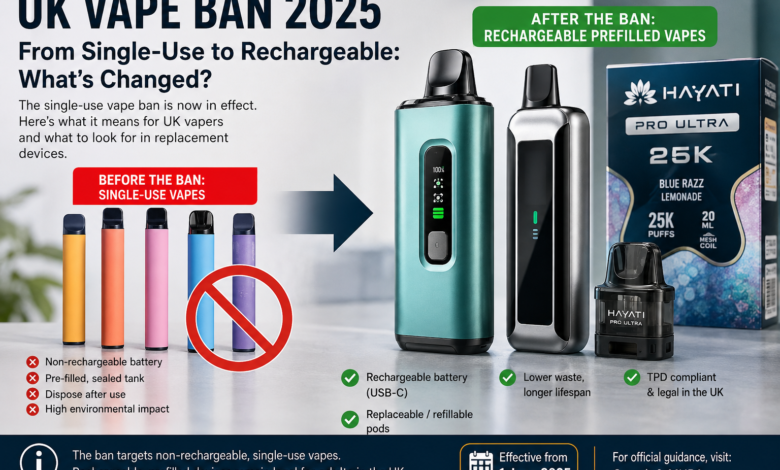
The UK vaping market went through one of its biggest structural shifts in years when the single-use vape ban came into force on 1 June 2025. Devices that were built around a sealed, non-rechargeable battery and a fixed e-liquid fill, designed to be thrown away once either ran out, were removed from sale. What replaced them was a wave of rechargeable prefilled vapes, built to the same general shape and ease of use but with a battery that can be topped up and, in many cases, a pod or tank that can be refilled or swapped rather than discarded.
This piece sets out what actually changed, why it happened, and what to look for now that non-rechargeable devices are no longer legally available.
Why the Ban Happened
The regulations were introduced primarily on environmental grounds. Non-rechargeable vapes combined a lithium battery, plastic housing and residual e-liquid into a single item that was rarely recycled correctly, and the volume of devices being discarded had grown sharply over several years. The ban falls under regulations enforced by the Department for Environment, Food and Rural Affairs, alongside equivalent bodies in Scotland, Wales and Northern Ireland, and applies to the sale of single-use vaping devices rather than vaping itself.
It is worth being precise here: the ban targets the single-use, non-rechargeable format specifically. Vaping products in general remain legal for adults in the UK and continue to be regulated under the Tobacco and Related Products Regulations (commonly referred to as TPD), which sets limits on tank size, e-liquid bottle volume and nicotine strength.
What a Non-Rechargeable Device Actually Was
Before the ban, a typical device combined three things into one sealed unit:
- A small lithium battery with no charging port, sized to last roughly as long as the e-liquid fill
- A pre-filled tank that could not be refilled or replaced
- A mouthpiece and coil built into the same housing as the battery and tank
Once either the battery or the e-liquid ran out, whichever happened first, the entire unit was discarded. There was no way to extend its life, which was the core of the environmental concern that led to the ban.
What Replaced Them: Rechargeable Prefilled Vapes
The devices that replaced single-use vapes on UK shelves follow a different structure. They still come prefilled from the manufacturer, so there is no need to handle raw e-liquid or build a coil, but two things now separate them from the format that was banned:
A rechargeable battery. Most current devices charge via USB-C, and the battery is designed to be reused across multiple pod or tank fills rather than discarded after one. This is the main functional shift driving the “rechargeable” label.
Replaceable or refillable pods. Rather than a single sealed tank, many devices now use a pod or container system that can be swapped or refilled once empty, extending the life of the device well beyond what a single-use battery and tank combination could offer. The Hayati Pro Ultra 25000 rechargeable prefilled vape is one example of this newer format, combining a rechargeable battery with prefilled pod and container components rather than a single fixed fill.
It is worth noting that “prefilled” and “refillable” are not the same thing. A prefilled device arrives ready to use with sealed e-liquid components, whereas a refillable device is designed for the user to add their own e-liquid. Most of the devices that replaced single-use vapes are prefilled and rechargeable, rather than refillable in the traditional open-system sense, though refillable pod kits also exist as a separate category.
What Buyers Should Check Now
With non-rechargeable devices off the market, the specs that matter when choosing a replacement have shifted slightly. It is worth checking:
- Charging method and battery capacity (mAh), since this now determines how many fill cycles the device can realistically support rather than being a one-time fixed limit
- Total e-liquid capacity across all pods or containers (ml), not just the figure for a single component
- Nicotine strength in mg/ml, which remains capped under TPD regardless of device format
- Whether pods are replaceable, refillable, or both, since this affects ongoing running cost
None of these figures were particularly relevant to comparing single-use devices, where the entire unit was disposed of as one. They matter considerably more now that a single device is expected to last across several refill cycles.
Regulatory Summary
To summarise the position as it currently stands in the UK:
- Single-use, non-rechargeable vaping devices cannot legally be sold as of 1 June 2025
- Rechargeable, prefilled devices remain legal and are the primary replacement format on the market
- All vaping products, regardless of format, remain subject to TPD limits on tank size, bottle volume and nicotine strength
- Nicotine strength must be displayed in mg/ml on compliant listings
- Guidance and enforcement details are available through Gov.uk and the Medicines and Healthcare products Regulatory Agency
The shift from non-rechargeable to rechargeable prefilled formats was primarily a response to environmental concerns around device disposal, not a change to nicotine limits or who can legally purchase these products. For anyone replacing an old single-use device, the practical difference comes down to charging the battery and managing pod or container refills rather than throwing the whole unit away.