Fortescue Zero: Driving the Future of Real Zero Industrial Decarbonisation
A Deep Dive into Clean Technology, Innovation, and the Path to Emission-Free Heavy Industry

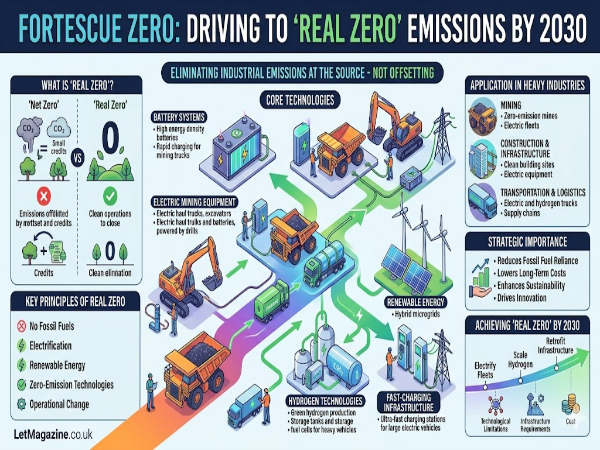
Fortescue Zero is the advanced engineering and technology division of Fortescue Metals Group, focused on eliminating industrial emissions through cutting-edge solutions such as electrification, battery systems, hydrogen technologies, and renewable energy integration. Its mission is to achieve “Real Zero” emissions by 2030, proving that heavy industries like mining, logistics, and infrastructure can operate without fossil fuels while maintaining performance, productivity, and profitability.
Introduction to Fortescue Zero
Fortescue Zero represents a bold shift in how large-scale industries approach sustainability. Rather than relying on carbon offsets or partial reductions, it focuses on completely eliminating emissions at the source. This approach challenges the traditional “net zero” model by pushing for “real zero”—a system where emissions are not balanced out but entirely removed.
As industries face increasing pressure to reduce their environmental footprint, Fortescue Zero is positioning itself as a leader in the global transition to clean energy technologies. Its work spans multiple sectors, but the core focus remains on transforming heavy industry operations into fully decarbonised systems.
The Concept of “Real Zero”
The concept of “Real Zero” is central to Fortescue Zero’s mission. Unlike “net zero,” which allows for the use of carbon credits or offsets to balance emissions, Real Zero means no emissions at all from operations.
Key principles of Real Zero:
Elimination of fossil fuel usage in operations
Electrification of machinery and transport
Use of renewable energy sources such as solar and wind
Development of zero-emission technologies
Focus on operational change rather than compensation
This philosophy reflects a growing belief that true sustainability can only be achieved by removing emissions entirely, not just offsetting them.
Core Technologies Developed by Fortescue Zero
Fortescue Zero is heavily invested in research, engineering, and innovation. Its technologies are designed to address some of the most challenging aspects of industrial decarbonisation.
Battery Systems
Battery technology is at the heart of Fortescue Zero’s solutions. These advanced systems are designed to power heavy-duty equipment such as mining trucks, rail systems, and industrial machinery.
Key features include:
High energy density
Rapid charging capability
Durability in extreme environments
Long lifecycle performance
These batteries are essential for replacing diesel-powered equipment in mining and construction industries.
Electric Mining Equipment
One of the most impactful areas of Fortescue Zero’s work is the electrification of mining fleets. Traditional mining relies heavily on diesel-powered vehicles, which are major contributors to greenhouse gas emissions.
Fortescue Zero is developing:
Electric haul trucks
Electric drills and excavators
Autonomous electric vehicles
These machines reduce emissions while also lowering operational costs over time.
Hydrogen Technologies
Hydrogen plays a significant role in the future of clean energy, and Fortescue Zero is actively developing hydrogen-based solutions.
Hydrogen can be used as:
A fuel source for heavy vehicles
A storage medium for renewable energy
A replacement for fossil fuels in industrial processes
Green hydrogen, produced using renewable energy, is particularly important as it emits no carbon when used.
Renewable Energy Integration
To support its electrification and hydrogen initiatives, Fortescue Zero integrates renewable energy sources into its systems.
These include:
Solar power installations
Wind energy systems
Hybrid renewable microgrids
By combining these sources, Fortescue Zero ensures a stable and sustainable energy supply for industrial operations.
Fast-Charging and Energy Infrastructure
One of the biggest challenges in electrifying heavy industry is charging infrastructure. Fortescue Zero is working on ultra-fast charging systems that can support large vehicles and equipment without significant downtime.
Features include:
High-power charging stations
Energy-efficient grid integration
Scalable infrastructure for remote locations
This ensures that electrified fleets can operate continuously without interruptions.
Application in Heavy Industries
Fortescue Zero’s technologies are designed specifically for industries that are traditionally difficult to decarbonise.
Mining Industry
Mining is one of the most energy-intensive industries in the world. Fortescue Zero is transforming mining operations by:
Replacing diesel trucks with electric alternatives
Using renewable energy to power mines
Implementing automated electric systems
Construction and Infrastructure
Heavy construction equipment is also being electrified, reducing emissions on building sites and infrastructure projects.
Transportation and Logistics
Electric and hydrogen-powered vehicles are being developed to reduce emissions in logistics networks, especially in remote and high-demand environments.
Strategic Importance of Fortescue Zero
Fortescue Zero is not just a technology initiative—it is a strategic move that positions Fortescue as a leader in the global energy transition.
Key strategic advantages:
Reduces reliance on fossil fuels
Lowers long-term operational costs
Enhances corporate sustainability credentials
Drives innovation and technological leadership
Aligns with global climate goals
By investing heavily in clean technologies, Fortescue is future-proofing its operations and setting a standard for others to follow.
Achieving “Real Zero” by 2030
Fortescue has set an ambitious goal: to achieve Real Zero emissions by 2030 in its Australian operations.
Steps toward achieving this goal include:
Electrifying all mining fleets
Transitioning to renewable energy
Scaling hydrogen production
Retrofitting existing infrastructure
Developing new zero-emission technologies
This timeline reflects both urgency and confidence in the available technologies.
Challenges in Reaching Real Zero
Despite its progress, Fortescue Zero faces several challenges:
Technological Limitations
Battery capacity, hydrogen storage, and energy efficiency are still evolving technologies.
Infrastructure Requirements
Large-scale electrification requires significant infrastructure investments, especially in remote areas.
Cost Considerations
Although costs are decreasing, initial investments in clean technology can be high.
Industry Resistance
Transitioning from fossil fuels requires changes in long-standing industrial practices.
Energy Supply Stability
Ensuring consistent renewable energy supply remains a challenge in some regions.
Innovations and Global Impact
Fortescue Zero’s work is influencing not just its own operations but also the broader global industry.
Contributions include:
Advancing clean energy technologies
Encouraging industry-wide decarbonisation
Demonstrating feasibility of zero-emission mining
Inspiring other companies to adopt similar strategies
Its innovations are helping reshape how industries think about energy, sustainability, and performance.
The Role of Leadership and Vision
Strong leadership is a critical factor in Fortescue Zero’s success. The company’s leadership has committed to bold climate goals and significant investments in clean technologies.
This vision is driven by:
Long-term sustainability thinking
Technological innovation
Environmental responsibility
Economic transformation
Such leadership is essential in driving large-scale change in complex industries.
Future of Fortescue Zero
Looking ahead, Fortescue Zero is expected to play a major role in shaping the future of clean industry.
Future developments may include:
More advanced battery technologies
Expansion of hydrogen infrastructure
Increased automation in electric systems
Global deployment of clean mining solutions
Integration of AI and smart energy management
The company’s ongoing research and development efforts will continue to push the boundaries of what is possible in industrial decarbonisation.
Conclusion
Fortescue Zero represents a transformative approach to industrial sustainability. By focusing on Real Zero emissions rather than offsets, it is redefining how heavy industries operate. Through innovations in battery systems, electric machinery, hydrogen technologies, and renewable energy, Fortescue Zero is paving the way for a cleaner, more sustainable future.
Its mission to achieve Real Zero by 2030 demonstrates that even the most energy-intensive industries can transition to zero-emission operations without compromising productivity. As the world moves toward a greener future, Fortescue Zero stands as a powerful example of how technology, vision, and commitment can drive meaningful change.