A train journey in India can be far more than a way to reach the next destination. On some routes, the view outside the window becomes the main reason to travel. Hills, tea gardens, rivers, coastlines and small stations pass by at a pace that makes it easier to notice the details.
The country’s rail network connects major cities with remote mountain towns and coastal communities. Some journeys run through busy urban areas, while others climb slowly into cooler regions where roads become narrow and the landscape begins to change.
For travellers who want to see more than airports and hotel rooms, rail travel offers a different rhythm. You can watch people board with packed meals, listen to the sounds of stations along the route and see how quickly one part of the country gives way to another.
The Darjeeling Himalayan Railway
The Darjeeling Himalayan Railway is often called the Toy Train, although that name does not fully reflect the scale of the journey. The train runs between New Jalpaiguri and Darjeeling in West Bengal, climbing through hills, forests and tea country towards the Himalayas.
The route opened in 1881 and uses loops and zigzags to handle the steep terrain. It travels slowly, which gives passengers time to see villages, roadside shops and mountain views that would be easy to miss from a car.
Darjeeling itself attracts visitors for tea estates, colonial era buildings and views towards Kanchenjunga. The journey by train adds something different because it feels closely tied to the landscape. The route does not cut through the region at high speed. It follows the shape of the hills.
The train can be busy during popular travel periods, so it is worth planning ahead. Its charm comes from the slower pace. This is not a route for anyone who wants to arrive quickly. It is for people happy to spend the day watching the scenery change.
The Nilgiri Mountain Railway
In the south of India, the Nilgiri Mountain Railway provides another memorable mountain journey. It runs between Mettupalayam and Ooty, climbing from warmer, lower ground into the Nilgiri Hills of Tamil Nadu.
The route passes through forested sections, tunnels, bridges and steep slopes. It uses a rack and pinion system on its sharpest gradients, which allows the train to keep climbing where an ordinary railway line would struggle.
The change in temperature is part of the experience. Mettupalayam can feel warm and busy, while Ooty has a cooler hill station atmosphere. As the train rises, the vegetation changes and the journey becomes greener.
Ooty has long been popular with Indian visitors looking to escape hotter cities. The railway makes the arrival feel more special because the trip itself becomes part of the break.
The Kalka to Shimla Railway
The Kalka to Shimla Railway connects the plains with the hill town of Shimla in Himachal Pradesh. It travels through mountain scenery, small stations, bridges and numerous tunnels on its way north.
Shimla became an important hill station during British rule, but the route remains appealing because of the landscape around it. The train moves through pine covered slopes and curves around the mountains, giving passengers views that road travel can make harder to enjoy.
Like the Darjeeling and Nilgiri lines, the Kalka to Shimla Railway forms part of the Mountain Railways of India World Heritage site. All three routes remain in operation and show the engineering needed to connect mountain communities more than a century ago.
The journey suits travellers who want to pair a city visit with time in the hills. Kalka is well connected to other northern cities, while Shimla offers cooler weather, walking routes and older buildings that give the town a distinct character.
The Konkan Railway gives a different view of India
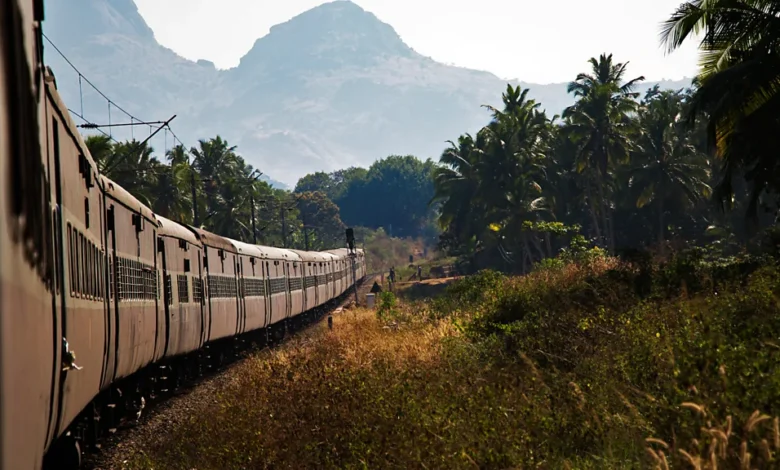
Not every scenic train journey needs mountains. The Konkan Railway runs along India’s western coast, connecting Maharashtra, Goa and Karnataka. It passes through rivers, fields, tunnels and stretches of tropical greenery.
The route becomes especially striking during and after the monsoon season, when the landscape turns intensely green and waterfalls appear in the hills. Coastal villages, palm trees and long bridges create a very different image of India from the busy streets of Mumbai or the dry landscapes of Rajasthan.
Goa is a common stop along the route, but the journey offers more than a way to reach the beach. It gives passengers a view of the Konkan coast that is difficult to get from major roads.
Anyone searching for cheap flights to India may focus first on Delhi, Mumbai or Bengaluru. Adding a rail journey afterwards can make the trip feel much broader, especially when the route passes through a region that would otherwise be missed.
Why train travel feels more personal
Flights make long journeys easier, but trains create space for the parts of a country that sit between major destinations. A trip that might feel like a simple line on a map becomes a series of small observations.
There are station vendors selling snacks and tea, families settling into long journeys and familiar routines that play out in each carriage. The view changes, but so does the atmosphere inside the train.
India’s most memorable rail routes do not rely on one famous landmark. Their appeal comes from the movement itself. A passenger can begin in a hot city, pass through farmland and arrive among hills without ever feeling disconnected from the journey.
That is why these routes are worth taking for more than transport. They offer a slower, more detailed way to see India.