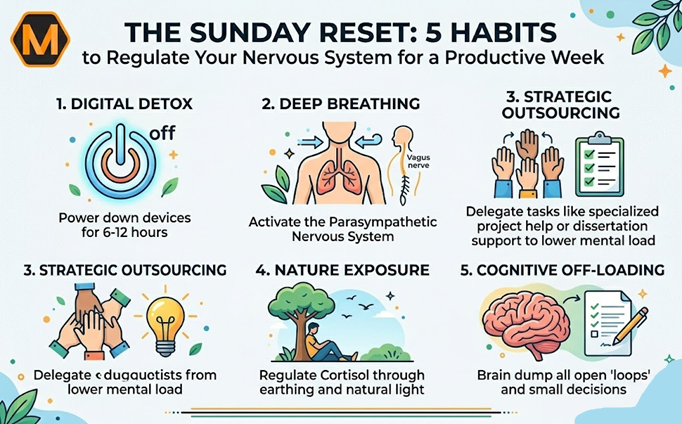
The modern professional and academic world is currently facing an invisible crisis: chronic nervous system dysregulation. We live in an era of “always-on” connectivity where the boundary between rest and work has completely dissolved. For many, Sunday is no longer a day of recovery; it has become a period of mounting anxiety, often referred to as the “Sunday Scaries.” However, biologically speaking, this isn’t just a mood—it is your body’s survival mechanism. When your brain perceives the upcoming week as a series of threats (deadlines, emails, social obligations), it triggers the sympathetic nervous system, placing you in a “fight or flight” state before Monday even begins.
To achieve peak performance in 2026, you must move beyond basic time management and embrace Nervous System Hygiene. This approach treats your biological state as the foundation of your productivity. If your nervous system is calm and regulated, your cognitive functions—like memory, logic, and creativity—operate at their highest potential. Conversely, a stressed system leads to “brain fog” and decision fatigue. Whether you are a student using Assignment Help at myassignmenthelp to manage a heavy workload or a professional balancing multiple projects, the goal remains the same: shifting your body from a state of high-stress arousal into the “Window of Tolerance.”
Understanding the “Window of Tolerance”
Before diving into the habits, it is essential to understand the biological framework of stress. Developed by Dr. Dan Siegel, the Window of Tolerance describes the zone where we can effectively manage our emotions and process information.
| State | Physical/Mental Symptoms | Impact on Productivity |
| Hyper-Arousal | Anxiety, racing thoughts, muscle tension, “Fight or Flight.” | High error rates, inability to focus on deep tasks. |
| Window of Tolerance | Calm, alert, emotionally steady, “Rest and Digest.” | Optimal State: High creativity and efficient problem-solving. |
| Hypo-Arousal | Numbness, exhaustion, depression, “Freeze” response. | Procrastination, lack of motivation, physical fatigue. |
Digital Sabbaticals and Cortisol Regulation
The first and perhaps most vital habit for a Sunday Reset is the Digital Sabbatical. Our nervous systems were not evolved to handle the constant barrage of blue light and dopamine-driven notifications that define the 2020s. Every time your phone buzzes, your adrenal glands release a micro-dose of cortisol. Over a week, these micro-doses accumulate, leaving your nervous system brittle and reactive.
A Digital Sabbatical is a period of at least six hours where you completely disconnect from the “Global Attention Economy.” This is not merely about ignoring emails; it is about allowing your brain to enter “Default Mode Network” (DMN). The DMN is the state your brain enters when it is not focused on an external task. It is during this time that your brain consolidates memories, solves complex problems subconsciously, and recovers from “Directed Attention Fatigue.”
How to implement it:
The Phone Jail: Place all devices in a drawer or a separate room by 11:00 AM on Sunday.
Analog Activities: Engage in high-sensory, low-tech hobbies. This could be cooking a complex meal without a digital recipe, sketching, or walking in a park without headphones.
The Result: By Sunday evening, your baseline heart rate will be lower, and your “mental bandwidth” will be significantly expanded for the week ahead.
Somatic Grounding: Moving Stress Out of the Body
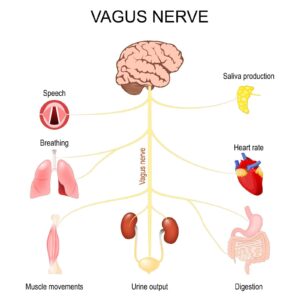
You cannot “think” your way out of a physiological stress response. If your shoulders are hiked up to your ears and your jaw is clenched, your brain receives a constant loop of feedback saying, “We are in danger.” To break this loop, you must use Somatic Grounding—physical techniques that signal safety directly to the brain via the Vagus Nerve.
The Vagus Nerve is the “superhighway” of the parasympathetic nervous system. It runs from the brainstem down to the abdomen, touching almost every major organ. When we stimulate this nerve, we manually flip the switch from “Stress” to “Relax.”
Key Somatic Techniques:
The Physiological Sigh: Take a deep breath in through the nose, followed by a second short “burst” of air at the very top, then a long, slow exhale through the mouth. Repeat three times to immediately offload carbon dioxide and calm the heart.
Cold Water Exposure: Splashing ice-cold water on your face or the back of your neck triggers the “Mammalian Dive Reflex,” which instantly slows the heart rate.
The 5-4-3-2-1 Method: Identify 5 things you see, 4 you feel, 3 you hear, 2 you smell, and 1 you taste. This pulls the brain out of “future-focused” anxiety and grounds it in the physical present.
Cognitive Offloading and Strategic Delegation
One of the primary triggers for the “Sunday Scaries” is the sheer volume of “Incompletes” swirling in our heads. In psychology, the Zeigarnik Effect suggests that our brains remember uncompleted tasks more vividly than completed ones. On Sunday, these unfinished tasks act like open browser tabs on a computer, draining your RAM and slowing down your system.
To fix this, you must practice Cognitive Offloading. This involves a rigorous “Brain Dump” where every worry, task, and project is moved from your mind onto a physical or digital medium. Once the information is externalized, the brain can stop “looping” on it.
As you perform this dump, you will often find that your “mental load” is physically impossible for one person to carry. This is the moment to look for professional avenues to lighten the burden. For instance, when academic pressure becomes a primary source of dysregulation, choosing to Pay for Assignments is not just about getting a grade—it is a strategic move to preserve your mental health and nervous system capacity for other high-priority learning.
Environmental Reset: The “Clean Slate” Protocol
Our external environment is a mirror of our internal state. A cluttered, chaotic living space provides constant visual stimuli that the brain must process, leading to low-level sensory overload. The “Clean Slate” protocol is about preparing your physical environment so that Monday morning feels like a fresh start rather than a continuation of last week’s mess.
The Sunday Reset Checklist:
The Workstation: Clear your desk of everything except the tools needed for your first task on Monday.
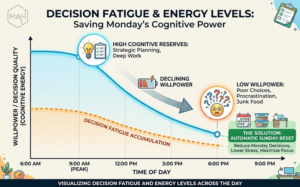
Meal Preparation: Pre-portioning high-protein, brain-healthy meals reduces the “Decision Fatigue” associated with dieting and nutrition during the work week.
The “Launch Pad”: Place your keys, bag, and pre-packed gym clothes by the door.
By removing these small friction points, you prevent your nervous system from spiking first thing Monday morning. You move from a “reactive” lifestyle to a “proactive” one.
Circadian Alignment and the Melatonin Bridge
The final habit is arguably the most important for long-term health: Circadian Alignment. Your body runs on a 24-hour internal clock that regulates everything from your temperature to your immune system. Sunday night is often when this clock gets “thrown off” because people stay up late trying to “reclaim” their weekend—a phenomenon known as Revenge Bedtime Procrastination.
To avoid this, you must build a “Melatonin Bridge.” This is a 90-minute window before sleep where you transition your body into its biological night.
How to Build the Bridge:
Light Hygiene: Turn off all overhead lights. Use warm-toned lamps or “amber” light bulbs. This signals to the pineal gland that it is time to produce melatonin.
Temperature Drop: A warm bath or shower 60 minutes before bed causes your core temperature to drop afterward, which is a key biological trigger for deep sleep.
The “No-Go” Zone: Avoid any media that induces a “high-arousal” state, such as thrillers, news cycles, or social media arguments.
Conclusion: The Competitive Advantage of Calm
In 2026, the people who thrive will not be those who work the hardest, but those who recover the most effectively. We are living in an “Attention Economy” where your ability to remain calm and focused is your greatest asset. By implementing these five habits—Digital Sabbaticals, Somatic Grounding, Cognitive Offloading, Environmental Resets, and Circadian Alignment—you are essentially upgrading your internal operating system.
A regulated nervous system allows you to approach your work with a sense of “Flow” rather than “Friction.” It enables you to handle the complexities of modern life—from high-level career demands to navigating the need for myassignmenthelp—without burning out. This Sunday, stop viewing rest as a luxury. Start viewing it as a professional requirement. When you win the Sunday Reset, you have already won the week.
Frequently Asked Questions
What is the “Window of Tolerance” in stress management?
The Window of Tolerance is a psychological concept describing the optimal zone of arousal where a person can function and process emotions effectively. When you are within this window, you can handle the challenges of the day without feeling overwhelmed (hyper-arousal) or completely shut down and exhausted (hypo-arousal).
How does a “Digital Sabbatical” help the nervous system?
Constant notifications and screen time trigger frequent spikes in cortisol, the body’s stress hormone. By stepping away from digital devices for a set period, you allow your brain to exit a reactive state. This break helps restore your attention span and gives your nervous system a much-needed chance to recalibrate to a resting baseline.
What are somatic grounding techniques?
Somatic grounding involves using physical movements or sensory awareness to pull the brain out of anxious “future-thinking” and back into the present moment. Techniques like deep rhythmic breathing or the 5-4-3-2-1 sensory method send direct signals of safety to the brain via the vagus nerve, physically lowering your heart rate and tension.
Why is decision fatigue higher on Monday mornings?
Decision fatigue occurs when the quality of your choices declines after a long period of decision-making. If you wake up on Monday without a plan, your brain immediately burns through its peak energy making small choices about clothes, food, and scheduling. Setting these details on Sunday preserves your mental energy for your most important tasks.
About The Author
Lucy Wilson is a senior academic consultant and strategist at MyAssignmentHelp. With over a decade of experience in higher education, she specializes in developing comprehensive student success frameworks and professional development resources. Lucy is dedicated to helping learners navigate complex academic landscapes through expert guidance and innovative research methodologies.