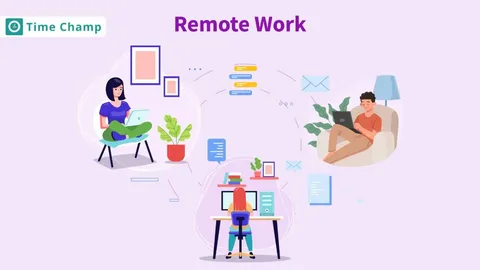
Remote work is very different from office work. Distributed teams may be located in various cities or even in different states and countries, while colleagues could be close by in the office environment. For a remote worker, it can be challenging to ensure equal levels of productivity and efficiency as compared to his or her office peers without certain tools.
Fortunately, there are many technological solutions that can be of great help in remote work. These are some essential tools that any company should give its remote workers, ranging from project management software to communication apps:
1. Cloud Cooperation
In a physical environment of the office, employees can collaborate with one another on a particular project simply by going to their colleague’s desk or scheduling a conference room for themselves. However, distant groups can do the same in a virtual world through the help of cloud collaboration tools. Through such virtual spaces, remote workers are able to share ideas, make comments on their peers’ works and even collaborate by editing one document at the same time.
Cloud collaboration solutions like Google Drive and Microsoft 365 come handy for remote workers. Through the help of these two platforms, any individual using any type of device can easily access files and folders.
2. Communication within the team
Team Messaging becomes a useful mode of communication for remote working employees. The employees can use team messaging applications on their office computers as well as mobile devices in order to communicate, exchange files, send messages, and indicate their availability.
The Team Messaging, Cloud Calling, Video Conferencing tools all get incorporated into one application through a unified communications software such as the RingCentral application; thereby, allowing employees to shift from one mode of communication to another by simply clicking once.
3. Conferencing via video
Video conferencing is the optimal choice when you need more interaction. Using team messaging software and e-mails may sometimes complicate the process of idea transfer as non-verbal cues take up to 93% of communication. Nevertheless, working from home over a long period of time might create a sense of isolation among workers and reduce productivity by 21%.
The use of video conferencing makes it possible for co-workers to see each other, which will make remote work more effective in terms of discussions regarding projects and building good relations. In any case, your unified communications system should offer video conferencing in addition to team messaging service. Employees would easily find necessary data without having to switch to other applications and schedule video conferences within one click.
4. Project Administration
As all employees are supposed to be, remote employees can also be more efficient than the ones who work from the office, yet they are always susceptible to distractions. Moreover, it may be difficult for the organization to ensure that everyone is synchronized, especially if the organization employs remote employees who work during different hours or even in other time zones.
With the help of project management software such as Asana, Wrike, and Trello, it becomes possible for remote workers to assign tasks, set deadlines, report statuses, and analyze the performance of the project immediately in one easy-to-use application. Moreover, a large number of project management applications let users have their tasks and projects represented in different views such as a calendar view, a to-do list, or a kanban board.
5. Storage of Data
Important work files must be located and accessed by remote workers as soon as possible. In order to avoid data breaches or hacks, remote employers must also make sure that their company’s files are exchanged and stored securely.
Organizational files are accessible to remote workers thanks to online data storage services like Dropbox and Google Drive. The majority enable users to specify sharing rights for each document, folder, or user so that files are accessible to the appropriate parties and to access files both offline and via mobile devices.
6. Efficiency
When they are not in the same room, remote team managers may find it difficult to gauge how much or how little their team is working. Additionally, businesses that track hours for client projects or hire hourly labor want a scalable and effective method for producing accurate timesheets and project reports.
Controlio, Toggl, Clockify, and Todoist are time management software that provide businesses with a comprehensive overview of their employees’ workweek. They can see exactly where their workers spend their time, and they may use this information to pinpoint time wasters and increase output.
7. Engagement of employees
Remote workers may begin to feel cut off from their jobs and teams if they don’t have frequent face-to-face time and opportunity to communicate with their coworkers. There is an assortment of technological solutions that will help companies keep their remote employees connected and engaged in a consistent manner, while at the same time, efforts such as virtual happy hours and all-hands meetings will help improve organizational culture.
The ability of such platforms as Kudos, WooBoard, and Kazoo to enable the sharing of accomplishments, announcements, and expressions of gratitude towards other colleagues allows remote workers to feel appreciated.
Appropriate tools are necessary.
It may take some time to organize the remote working environment for an organization correctly, but it does not need to be too complicated. Contemporary technology enables remote teams to utilize the advantages of flexible working hours along with imitating many aspects of their in-office experience remotely.
The communication and collaboration platform of the organization is the basis of the remote working experience. In order to keep the constant communication with colleagues, the remote employees must have such tools as cloud phones, video conferences, and team chats at their disposal. Employees will be able to concentrate on productivity and goals of the company due to unified communications.