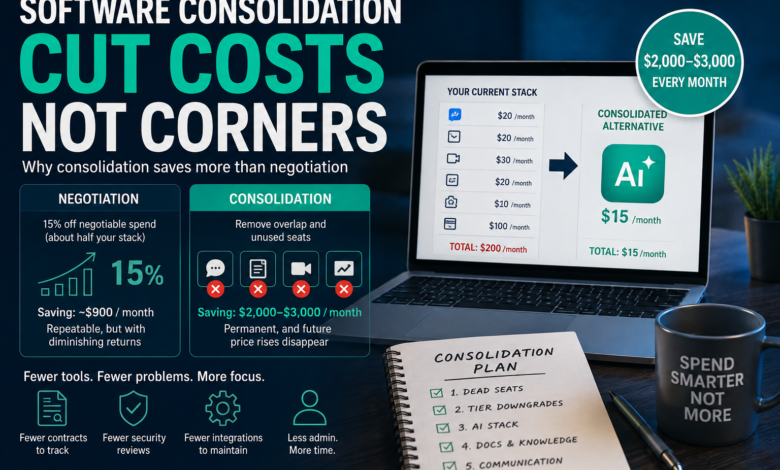
There are two ways to reduce a software bill. You can pay less for what you have, or you can have less.
The first is where almost all the effort goes. Renewal calendars, benchmark data, competitive quotes, a well-run negotiation that lands 15% off. It feels like a win, it is measurable, and it is a legitimate skill.
The second is where almost all the money is. And the reason it gets neglected is not that people do not understand it — it is that consolidation requires a decision, and negotiation only requires a meeting.
The maths, plainly
Take a team spending $12,000 a month on software.
Negotiation path. You take renewals seriously for a year, benchmark aggressively, and win 15% across the negotiable portion — realistically about half the stack, since infrastructure and small tools have no leverage. Saving: roughly $900 a month. Repeatable, but with diminishing returns; the second year’s negotiation starts from the lower base.
Consolidation path. You find that four tools overlap and three of them can go, and that a further $1,400 sits in seats nobody has opened in a month. Saving: $2,000–3,000 a month. Permanent, because the spend does not exist any more rather than being temporarily discounted.
The gap is not marginal. And it compounds differently: a discount is a percentage of an ongoing bill, while consolidation removes the bill and every future price increase attached to it.
There is a second-order effect too. Fewer vendors means fewer contracts to track, fewer renewal dates to miss, fewer admin panels to audit, fewer security reviews, fewer integrations to maintain. That overhead is real and almost never appears in the savings calculation.
Why teams negotiate instead
Four reasons, all rational in the moment.
Negotiation is nobody’s decision. Asking for a discount requires no internal agreement. Removing a tool means telling someone their tool is going, and that is a conversation.
The renewal date creates urgency. Consolidation has no deadline, so it is permanently next quarter’s project.
Discounts are easy to report. “I saved 15%” is a clean sentence. “I removed a category of duplicated spend after a two-week review” needs explaining.
Switching costs are visible; duplication costs are not. The migration effort is concrete and immediate. The overlap you are paying for is abstract and spread across twelve invoices.
Understanding this is the point. Consolidation loses to negotiation for organisational reasons, not economic ones, which means fixing the organisational part is most of the work.
Where the overlap actually hides
Duplication is rarely two identical tools. It is usually four tools each doing 30% of the same job.
Communication. Chat, video, async video, project comments. Genuine overlap, high switching cost, hard to consolidate. Attack last.
Documents and knowledge. Wiki, docs, notes app, shared drive. Enormous overlap, moderate switching cost, and information is scattered enough that consolidating improves the product as well as the bill.
Design and creative. Design tool, whiteboard, image editor, stock library. Moderate overlap. Usually a seat-count problem rather than a tool-count problem.
AI and assistants. The newest category and the most duplicated. Multiple chat assistants, a code assistant, an image generator, a research tool. This is where consolidation pays fastest, for three specific reasons:
- The tools genuinely overlap — most assistants do most of the same things
- They were bought individually, so nobody ever compared them side by side
- The category has a real consolidated alternative, which many categories do not
Start here. An AI subscription cost calculator gives you the number in a couple of minutes: select the plans your team currently holds, and it returns your monthly and annual totals against a single-subscription figure. For most teams running three or more assistants, the gap is large enough to fund the rest of the consolidation programme on its own.
The sequencing that works
Consolidation projects fail when they start with the hardest category. Work in this order.
Phase 1 — dead seats (week one). Licences held by departed staff, and licences held by current staff who have not logged in for thirty days. No migration, no debate, no approval. Typically 5–15% of the bill.
Phase 2 — tier downgrades (week two). Enterprise tiers bought for one feature nobody uses. Premium plans someone upgraded during a busy month. Check what each tier actually adds against what you use.
Phase 3 — the AI stack (weeks three to four). Highest overlap, lowest switching cost, and a mature consolidated alternative. Multi-model platforms bundle several labs’ models into one account, and published tier pricing in this category generally starts around $15/month for an individual allowance, rising to team plans with pooled credits. Compare that against your current AI bucket total, not against a single subscription.
Phase 4 — documents and knowledge (month two). Real work, real payoff, moderate disruption.
Phase 5 — communication (later, maybe never). Highest switching cost, most political. Only attempt with genuine executive backing.
Each phase funds the next in credibility as much as in cash. Phase 1 costs nothing and produces a number, which is what buys you permission for Phase 3.
Where consolidation is genuinely the wrong answer
It is not universally correct, and pretending otherwise gets people burned.
When the consolidated tool is materially worse at your core workflow. Saving $400 a month while making your best people slower is a bad trade, and it is a trade that is easy to make by accident because the saving is measured and the slowdown is not.
When switching cost exceeds two years of savings. Migration is not free. Count the hours honestly, at real salary cost, before committing.
When you are consolidating onto a fragile vendor. Concentrating your stack on a company that may not exist in three years is risk transfer, not risk reduction.
When the “overlap” is actually redundancy you chose. Some duplication is deliberate resilience. Know which of yours is.
Making the decision stick
Three practices separate teams that consolidate once from teams that stay consolidated.
Name a category owner. Unowned categories re-sprawl within two quarters. Somebody approves new tools in each category, and it is a named person rather than a process.
Require a duplication check at purchase. One question on any new software request: what does this replace? If the answer is “nothing”, it needs a reason.
Re-run the audit quarterly. Sprawl is not an event, it is a rate. A quarterly ninety-minute review keeps it flat; an annual one lets it double.
Frequently asked questions
How much can software consolidation actually save? Teams that have never audited typically find 20–35% in the first pass, dominated by dead seats and duplicated categories. Teams that audit regularly find far less, which is the point of auditing regularly.
Should you negotiate or consolidate first? Consolidate first. Negotiating a discount on a tool you are about to cancel wastes the leverage and the time. Once the stack is right, negotiate the survivors — you will have better data and a credible alternative, which is what actually moves a price.
What is the fastest consolidation win? Dead seats, then the AI bucket. Both require no migration, and the AI bucket has the highest overlap rate of any category in most modern stacks.
Does consolidation increase vendor lock-in risk? Yes, and it should be priced in. Check data export before committing, prefer vendors with portable formats, and avoid consolidating a genuinely critical function onto a single small vendor.
The uncomfortable summary
A 15% discount on spend you should not have is worse than a 100% saving on spend you remove. Both take work. Only one of them requires deciding something, which is exactly why the other one gets done.
Start with the dead seats this week, price the AI bucket against a consolidated alternative next week, and let the number make the argument for you.