Kellogg Innovation Network: A Global Leadership Hub for Transformative Innovation
How the Kellogg Innovation Network Drives Cross‑Sector Collaboration, Strategic Action, and Real‑World Impact

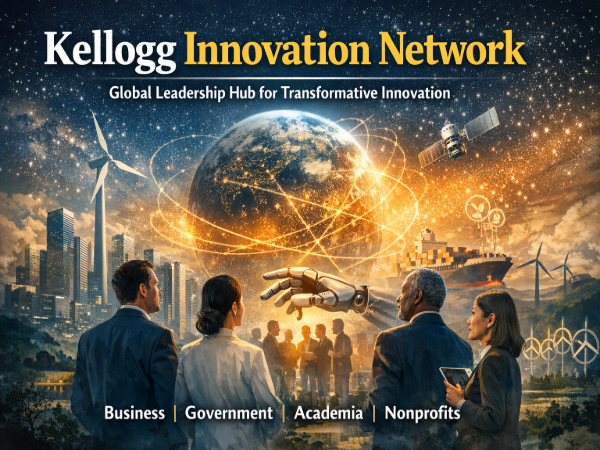
Kellogg Innovation Network is a global initiative founded in 2003 at the Kellogg School of Management by Professor Robert C. Wolcott, designed to connect senior leaders from business, government, academia, and nonprofit sectors to address complex global challenges through collaborative innovation, strategy design, and actionable partnerships. With its invitation‑only membership model, the network fosters high‑level dialogue and transforms ideas into practical solutions that create long‑term value across industries and societies.
Introduction: A Catalyst for Innovation Leadership
In an era defined by rapid technological change, economic shifts, and increasingly complex societal challenges, the ability to innovate has never been more critical. Yet innovation does not occur in isolation. It thrives where diverse perspectives meet and intersect — bringing together expertise from business, government, academia, and social sectors. At the heart of this collaborative imperative stands the Kellogg Innovation Network, an influential global forum that has reshaped the way leaders think about innovation, partnerships, and strategic transformation. Founded in 2003 by Professor Robert C. Wolcott at the Kellogg School of Management, the network has become a hub for senior decision‑makers committed to turning visionary ideas into measurable impact.
Understanding the Kellogg Innovation Network
Origins and Founding Vision
The Kellogg Innovation Network was conceived during a time when traditional approaches to leadership and strategy were no longer sufficient to navigate disruptive change. Professor Robert C. Wolcott, a scholar and practitioner with a deep interest in innovation ecosystems, envisioned a platform where seasoned leaders across sectors could engage in meaningful dialogue, explore emerging trends, and co‑design solutions to shared challenges. From its inception, KIN was anchored in the principle that innovation should be both strategic and actionable — not confined to academic theory or isolated corporate labs.
The Invitation‑Only Model
One of the defining features of the network is its invitation‑only membership structure. By bringing together senior executives, policymakers, researchers, and nonprofit leaders, KIN ensures a high level of engagement and depth in discussion. This model promotes trust, encourages candid exchange, and fosters long‑term collaboration among peers who are directly responsible for driving innovation within their organizations.
A Global Reach with Local Impact
Though rooted in the academic environment of the Kellogg School of Management, the influence of the Kellogg Innovation Network extends far beyond its home institution. With participants and partners from around the globe, KIN operates as a truly international forum. Members contribute unique regional perspectives while collectively working toward solutions that have global relevance and local impact.
Core Goals and Mission of the Network
Driving Cross‑Sector Dialogue
At its core, the Kellogg Innovation Network exists to bridge traditionally siloed sectors. Business leaders may bring insights on competitive strategy and scaling innovation. Government officials contribute perspectives on policy, regulation, and public welfare. Academia offers research‑based frameworks for understanding complex systems. Nonprofits share frontline experience in social impact and community engagement. The network’s mission is to foster meaningful dialogue across these domains — so that innovation is informed by a diversity of experience and expertise.
Transforming Ideas into Action
Many forums or conferences stimulate conversation, but the Kellogg Innovation Network places equal emphasis on actionable outcomes. Whether through pilot projects, strategic partnerships, research initiatives, or operational frameworks, the network encourages members to translate collaborative insights into real‑world results. This focus on implementation distinguishes KIN from many traditional academic or corporate innovation networks.
Promoting Sustainable and Inclusive Innovation
Innovation without consideration for sustainability and inclusion can lead to uneven benefits or unintended harm. The network deliberately spotlight issues such as equitable access to technology, sustainable development practices, and ethical leadership. By cultivating a culture that values inclusive innovation, KIN contributes not only to economic progress, but to social well‑being and environmental stewardship.
Flagship Activities and Engagement Platforms
KIN Global Summits
Each year, the network hosts a flagship gathering — the KIN Global Summit — where members convene for immersive discussions, workshops, and strategic labs. These summits serve as incubators for cross‑sector collaboration, with sessions designed to explore emerging trends, test innovative frameworks, and strengthen professional networks. Unlike traditional conferences, KIN summits prioritize depth over breadth, encouraging sustained engagement rather than superficial attendance.
Innovation Expeditions
To complement theoretical insights with real‑world exposure, the network organizes Innovation Expeditions to prominent global innovation hubs. These expeditions take members to cities and ecosystems where transformative ideas are being prototyped and scaled — offering direct learning opportunities from leaders in technology, policy, and cultural advancement. Through these experiences, participants gain firsthand understanding of how innovation operates in different contexts and how lessons from one ecosystem can inform strategies elsewhere.
Catalyst Forums and Working Groups
Beyond annual summits and expeditions, the Kellogg Innovation Network supports ongoing forums and working groups around specific themes or challenges. These may include industry‑focused collaborations, cross‑sector challenge teams, or long‑term strategic initiatives. By facilitating sustained engagement, the network advances deeper inquiry and enables members to co‑create solutions with measurable outcomes.
Workshops and Applied Learning Sessions
KIN regularly facilitates workshops aimed at equipping members with practical tools for innovation leadership. These sessions draw from methodologies such as design thinking, systems thinking, strategic foresight, and rapid prototyping. Designed to be interactive, they empower leaders to apply new frameworks directly to organizational problems.
Impact Stories: How KIN Drives Change
Fostering Strategic Partnerships
One of the most visible contributions of the Kellogg Innovation Network lies in the strategic partnerships it cultivates. By connecting executives across sectors, KIN has facilitated alliances that might otherwise never have formed. For instance, business leaders have collaborated with public sector innovators to develop scalable solutions for workforce development. Academia and nonprofit organizations have partnered to conduct research that informs policy design. These partnerships often lead to sustained initiatives that extend well beyond the network’s events.
Influencing Organizational Strategy
Members frequently report that their involvement in KIN has transformed strategic thinking within their organizations. Exposure to diverse perspectives and rigorous dialogue encourages leaders to reassess assumptions, incorporate new frameworks, and adopt innovation practices that improve agility and resilience. In sectors ranging from healthcare to renewable energy, KIN alumni have brought back insights that reshape internal processes and strategic roadmaps.
Elevating Global Conversations on Innovation
In addition to its direct impact on participants, the Kellogg Innovation Network plays a role in elevating conversations about innovation at the global level. Through its research initiatives, public thought leadership, and collaboration with partner institutions, KIN contributes to broader understanding of how innovation can be managed responsibly and equitably in an interconnected world.
Why the Network Matters in Today’s World
Responding to Complex Challenges
In the face of global challenges such as climate change, economic inequality, and technological disruption, no single sector can claim all the answers. The Kellogg Innovation Network matters precisely because it embraces complexity — not as a barrier to action, but as a reason for collective ingenuity. By enabling dialogue between diverse leaders, the network accelerates solutions that are holistic, informed, and sustainable.
Encouraging Systems‑Level Thinking
Innovation is often mistaken for generating new products or technologies alone. The network shifts this narrative by emphasizing **systems‑level approaches — understanding relationships, patterns, and dynamics that shape outcomes. Systems thinking allows leaders to identify leverage points where innovation can create the most meaningful change.
Building Leadership Capacity for the Future
The leaders engaged in KIN are not only practitioners of innovation today; they are shaping the conditions for innovation in the decades ahead. By expanding leadership capacity — especially in areas such as ethical decision‑making, inclusive strategy, and cross‑sector negotiation — the network contributes to a stronger foundation for future progress.
What Makes KIN Different from Other Innovation Networks
Depth of Engagement
Unlike many industry networks or professional associations, KIN prioritizes deep engagement over broad membership. The invitation‑only model ensures that participants have the authority and experience to influence change within their organizations and sectors.
Integration of Theory and Practice
While rooted in academic excellence, the network does not remain confined to scholarly dialogue. Instead, it bridges academic insights with real‑world practice, enabling members to leverage rigorous frameworks while testing them in live operational environments.
Cross‑Sector Orientation
Many networks focus on a single sector — for example, tech innovation hubs or nonprofit leadership circles. KIN intentionally crosses these boundaries, understanding that innovation often occurs at the intersection of disciplines, where insights from one field illuminate possibilities in another.
Future Directions and Continued Relevance
As the global landscape evolves, so too does the importance of networks that support purposeful innovation. The Kellogg Innovation Network continues to expand its footprint, adapting to emerging trends and expanding the scope of its collaborative work. Areas such as digital transformation, responsible AI, climate adaptation, and equitable economic development are increasingly integrated into the network’s conversations and initiatives.
By staying true to its founding principles — collaboration, action‑orientation, diversity of thought, and practical impact — KIN remains a leading forum for innovation leadership in the 21st century.
Conclusion: The Legacy and Promise of KIN
The Kellogg Innovation Network represents more than an elite forum for senior executives. It is a living ecosystem of thinkers and doers who are committed to advancing innovation with purpose and integrity. Through its thoughtful convenings, strategic partnerships, and emphasis on actionable insights, KIN has earned its reputation as a powerful engine of cross‑sector collaboration and transformative impact.
For leaders seeking to navigate complexity, foster meaningful partnerships, and contribute to real‑world change, the network offers not just connection, but inspiration, tools, and community — proving that innovation is most powerful when it is shared, inclusive, and driven by action.