If you have ever had to cut trees in Minecraft, plant seeds in Stardew Valley, or construct a city in SimCity, you can easily understand how a simulation game works. You begin with nothing, adhere to the rule set, and see how things develop from there. As it happens, this cycle is now attracting a totally new batch of people to cryptocurrency through gaming.
Simulation Games Are Sneaking Into Crypto
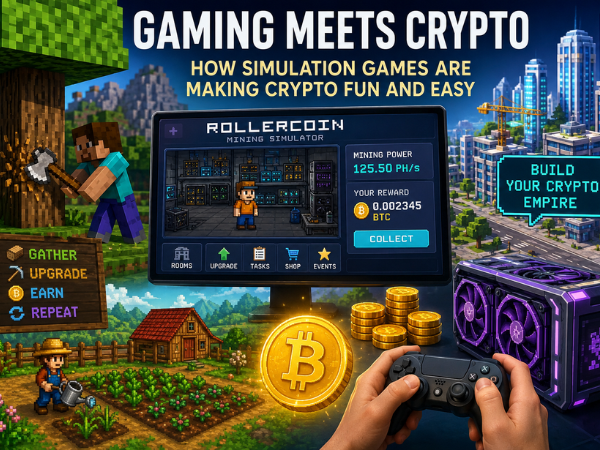
Simulation games follow a simple cycle that involves gathering resources, improving equipment, unlocking the next level, and repeating this cycle. Farming games helped players understand the idea of supply and reinvestments without naming these concepts. Tycoon games introduced the basics of economics.
Crypto platforms have started borrowing this playbook. Instead of throwing newcomers head-first into hash rates and block rewards, some projects wrap those mechanics in a game format players already understand. For instance, there is RollerCoin, a mining simulator game, where you build your own virtual mining setup, grow your mining power, and earn crypto by playing mini-games. And it isn’t just a game with a mining skin — the rewards are real crypto you can actually withdraw.
Why Gamers Are Into This
A few reasons this format is catching on:
- It’s easy to jump into. If you’ve played any resource-management or idle game, you already know how to play a mining sim.
- Progress actually feels like something. Upgrading gear and climbing rankings is different than just watching a number in a wallet.
- You can start for free. No need to buy hardware or put money in upfront just to try it out.
- The rewards are real. Since what you earn has actual value, people stick around a lot longer than they would with a typical mobile game.
- There’s a community angle. Leaderboards and competition tap into the same stuff that makes multiplayer farming and city-building games addictive.
When put into perspective, what should be a rather boring and technical field suddenly becomes like leveling up an in-game character. There is no need to know any specialized crypto terminology; it comes automatically with the upgrades.
This kind of immersive approach can make complex digital concepts easier to understand by turning abstract ideas into something more familiar and interactive. A good example is Dubai recreated in Aether, which offers a creative way to explore a digitally recreated environment and see how technology can transform the way people experience information and virtual spaces.
Gamers and Investors Are Starting to Overlap
What is fascinating in this case is that it brings together two groups who previously had no interaction with each other. Those who did not care about money are now interested in the stock market since it influences their earnings in the game. And those who were scared of cryptocurrencies are now at ease with them due to the game.
This works because gamers already think in a way that maps pretty well onto investing. Decide whether to save up gold or spend it now, whether to upgrade gear or hold off – that’s basically the same thing as deciding whether to reinvest crypto earnings into better mining power or cash out. Nobody sits the player down and explains this is “risk management.” It just happens naturally as part of playing the game.
It’s also changing what each side expects from the other. Gamers want crypto platforms to actually feel fun, not just a screen full of charts and numbers. And crypto projects are realizing that wrapping things in a game is a good way to reach people who’d otherwise never bother opening an exchange app. So you end up with games that quietly teach people about money, and crypto platforms that borrow tricks from game design to keep people interested.
That is one of the reasons these games are growing faster than any tutorial ever could. A video will teach you about mining. Games let you practice mining.
Where This Is Headed
With the expansion of crypto, there will be an increasing tendency for platforms to emulate genres of simulations that have already proven themselves – farming, tycoons, city-building – rather than to attempt to create some kind of unique game genre.
If you are a gamer interested in crypto, then this is most likely the easiest way for you to dive into the world of cryptocurrencies. You don’t even need to understand how this technology works, just build your own infrastructure.