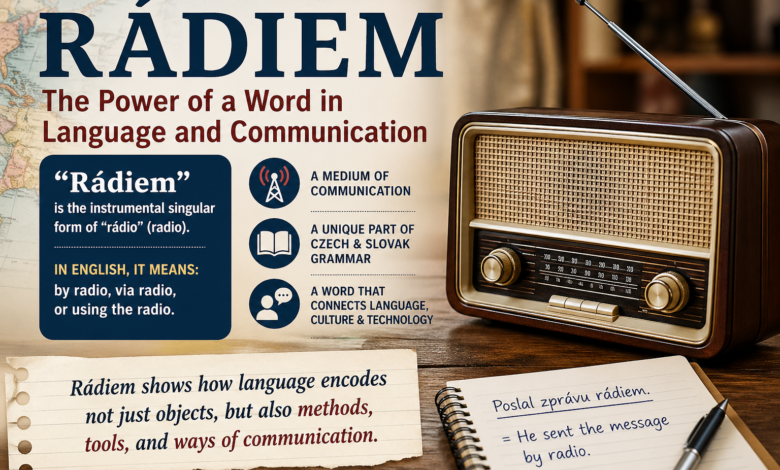
Rádiem is the instrumental singular form of the Czech and Slovak noun “rádio,” meaning “radio.” In English, it translates to “by radio,” “via radio,” or “using the radio.” This grammatical form demonstrates how Slavic languages encode the method or medium of an action directly into the structure of a word. Rather than relying on additional prepositions like English, the instrumental case allows a single word—rádiem—to express both the object and the means by which something occurs.
Table of Contents
ToggleIntroduction: A Simple Word with Complex Meaning
At first glance, the word “rádiem” may appear ordinary, even insignificant. It is short, easy to pronounce, and unfamiliar to those outside Czech or Slovak linguistic circles. However, beneath this simplicity lies a remarkable example of how language can compress meaning into a single form. Rádiem is not just a variation of the word “radio”; it is a demonstration of how grammar, communication, and cultural evolution intersect.
Understanding this word opens a door into the broader mechanics of Slavic languages, where word endings are not arbitrary but deeply meaningful. In a world where communication is constantly evolving—from traditional radio broadcasts to digital streaming—the word rádiem still holds relevance. It bridges the past and present, illustrating both linguistic tradition and technological continuity.
Understanding the Meaning of Rádiem
Rádiem comes from the base noun “rádio,” which simply means “radio.” However, unlike English, where meaning often depends on word order and helper words, Czech and Slovak use grammatical cases to modify meaning. Rádiem is the instrumental case form, specifically singular.
In practical terms, this means the word answers the question: “By what means?” or “Using what?”
For example:
“He sent the message by radio” becomes a structure where “rádiem” replaces the phrase “by radio.”
This transformation is efficient. Instead of adding extra words, the language embeds the function directly into the noun. The result is a compact yet expressive way of conveying information.
The Instrumental Case Explained
To fully understand rádiem, one must grasp the concept of the instrumental case. In Czech and Slovak grammar, the instrumental case is used to indicate the means, tool, or method by which an action is performed.
This case is not limited to communication. It applies broadly across contexts, including tools, companions, and methods. For example:
Writing with a pen
Traveling by car
Communicating by radio
In each of these cases, the instrumental form signals how the action happens. Rádiem fits perfectly into this system, showing that radio is the medium used.
What makes this fascinating is how natural it feels to native speakers. While English speakers rely on prepositions like “by” or “with,” Czech and Slovak speakers instinctively modify the noun itself.
Why Rádiem Matters in Linguistics
From a linguistic perspective, rádiem is more than just a word—it is a case study in how languages structure meaning. It highlights a key difference between analytic languages like English and synthetic languages like Czech.
English tends to separate meaning into multiple words:
“by radio” (two words)
Czech condenses that meaning into one:
“rádiem” (one word)
This efficiency reflects a broader pattern in Slavic languages, where endings carry grammatical weight. These endings indicate not only function but also relationships between words in a sentence.
For linguists, words like rádiem are valuable because they demonstrate how grammar can encode context. They show that meaning does not always depend on sentence structure; sometimes, it is built directly into the word itself.
Cultural Significance of the Word
Language is never just about communication—it is also about culture. The word rádiem carries subtle cultural significance, particularly in regions where radio played a central role in daily life.
In the past, radio was a primary source of news, entertainment, and connection. Families gathered around radios to listen to broadcasts, and important announcements were often delivered through this medium. In such contexts, the phrase “by radio” was not abstract—it was part of everyday experience.
The existence of a specific grammatical form like rádiem reflects this importance. It shows that communication methods were significant enough to be embedded directly into the language.
Even today, the word retains this cultural resonance. While technology has advanced, radio remains a trusted and accessible medium in many parts of the world.
Technological Context: From Radio to Digital Media
Although rádiem originates from a time when radio was dominant, its relevance extends into the modern technological landscape. The concept it represents—communication through a medium—has not disappeared. It has simply evolved.
Today, we communicate through:
Internet platforms
Mobile networks
Streaming services
Yet the underlying idea remains the same: messages are transmitted through a channel. Rádiem symbolizes this concept in its simplest form.
It reminds us that even as technology changes, the fundamental principles of communication remain constant. Whether a message is sent by radio, internet, or satellite, the idea of a medium persists.
Comparing Rádiem with English Structure
One of the most interesting aspects of rádiem is how it contrasts with English. In English, meaning is often constructed through separate words. Prepositions like “by,” “with,” and “through” play a crucial role.
For example:
“by radio”
“with a phone”
“through the internet”
In Czech and Slovak, these meanings are often embedded directly into the noun through case endings. This creates a more compact structure but requires a deeper understanding of grammar.
For learners, this difference can be challenging. It requires a shift in thinking—from building meaning with multiple words to recognizing how a single word can carry multiple layers of information.
Real-Life Usage of Rádiem
Despite its grammatical complexity, rádiem is used naturally in everyday language. It appears in conversations, media, and formal communication.
Examples include:
Reporting how information was received
Describing methods of communication
Explaining how messages are transmitted
Its usage is not limited to technical contexts. It can appear in casual speech as easily as in formal writing. This versatility makes it a practical and important part of the language.
Common Misunderstandings
Because rádiem is not an English word, it is often misunderstood by non-native speakers. Some people confuse it with similar-looking words such as “radium,” which is a chemical element, or “radian,” a mathematical term.
These similarities are purely visual. The meanings are entirely unrelated. Rádiem is strictly linguistic and tied to communication.
Another common misunderstanding is assuming that it refers to the radio device itself. In reality, it refers to the method of using the radio, not the object alone.
The Role of Grammar in Meaning
Rádiem highlights an important truth about language: grammar is not just a set of rules; it is a system for conveying meaning. In Czech and Slovak, grammar plays a central role in communication.
Word endings are not optional—they are essential. They indicate relationships, functions, and context. Without them, sentences would lose clarity.
This makes words like rádiem powerful. They show how much information can be packed into a single form when grammar is used effectively.
Learning from Rádiem
For language learners, rádiem offers valuable lessons. It teaches the importance of understanding grammatical cases and how they function.
Rather than memorizing translations, learners must understand the logic behind the language. They must recognize that meaning is not always expressed in the same way across languages.
Studying words like rádiem can improve overall language awareness. It encourages learners to think more deeply about how communication works.
Broader Implications in Language Study
Beyond Czech and Slovak, the concept behind rádiem applies to many other languages. Various linguistic systems use cases or inflections to encode meaning.
By studying such words, linguists can compare different language structures and understand how humans communicate across cultures.
Rádiem serves as a small but meaningful example of this larger phenomenon. It shows that even a single word can reveal complex patterns in language.
Conclusion: The Power of a Single Word
Rádiem may seem like a minor detail in the vast landscape of language, but it carries significant meaning. It represents the intersection of grammar, culture, and technology. It demonstrates how languages can encode complex ideas into simple forms.
By understanding rádiem, we gain insight into how Czech and Slovak languages function. We see how communication methods are built directly into words. We also recognize the enduring importance of mediums like radio in shaping language and culture.
Ultimately, rádiem is more than just a word. It is a reminder that language is a powerful tool—capable of expressing not only what we say, but how we say it.