Beyond the Binary: Why the Indica and Sativa Classification System Is More Complex Than Most People Realise

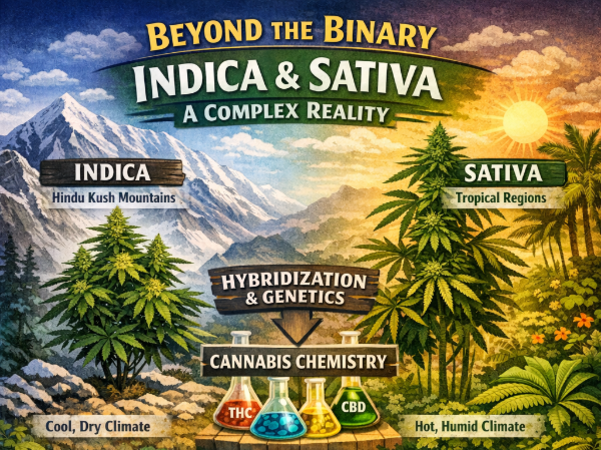
For decades, the cannabis world has operated on a seemingly straightforward taxonomic divide. Ask most collectors or horticulturalists to describe a variety and the conversation almost inevitably begins with a familiar question — is it indica or sativa? Yet the more botanists, geneticists, and experienced growers examine this classification system, the clearer it becomes that the binary model tells only a fraction of the story.
The Origins of a Oversimplified System
The formal distinction between cannabis indica and cannabis sativa dates back to the eighteenth century, when botanist Jean-Baptiste Lamarck identified morphological differences between plants sourced from India and those already documented in Europe. His observations were based entirely on physical characteristics — plant height, leaf shape, branching structure, and growth density.
What Lamarck could not have known, working centuries before modern genetic sequencing, was that physical morphology and chemical expression do not map neatly onto each other. A plant can display the compact, broad-leafed appearance typically associated with indica strains while expressing a cannabinoid and terpene profile that bears little resemblance to what modern consumers associate with that category.
What Sativa Strains Actually Represent Botanically
The term sativa strains, in its original botanical context, described tall, narrow-leafed cannabis plants that thrived in equatorial and tropical climates — regions with long growing seasons, high humidity, and intense light exposure. These plants adapted to their environments over centuries, developing extended flowering periods and considerable vertical height as responses to their native conditions.
Botanically, these characteristics reflect genuine genetic adaptations. The narrow leaf structure reduces water loss in humid environments. The extended flowering period aligns with the longer equatorial days. The height allows the plant to compete for light in dense tropical vegetation. Understanding sativa strains through this ecological lens reveals far more than a simple consumer classification ever could.
The Indica Picture Is Equally Nuanced
Similarly, what we understand as indica strains developed primarily across the Hindu Kush mountain range, encompassing regions of Afghanistan, Pakistan, and northern India. The environmental pressures here were dramatically different — shorter growing seasons, significant temperature variation between day and night, and considerably less humidity than equatorial regions.
The compact structure, dense branching, and faster maturation rate associated with indica strains are not arbitrary characteristics. They represent thousands of years of adaptation to a specific, demanding environment. Plants that matured quickly before the harsh mountain winter arrived survived to reproduce. Those that did not survive, did not reproduce. The genetics we associate with indica today are quite literally the survivors of an ancient environmental selection process.
The Genetic Reality Behind Modern Varieties
Here is where the contemporary cannabis seed world diverges significantly from the classical botanical model. Virtually every variety available through established seed banks today represents some degree of hybridisation between these foundational genetic lineages. Decades of deliberate breeding programmes have crossed, recrossed, backcrossed, and stabilised genetics from both categories so thoroughly that the original distinction has become taxonomically blurred.
Research published in recent years has demonstrated that the chemical profiles of cannabis varieties — the actual terpene and cannabinoid combinations — correlate very weakly with the indica or sativa labels applied to them. Two varieties both marketed under the same classification can express dramatically different chemical compositions, while two varieties from supposedly opposite categories can share remarkably similar profiles.
Terpenes: The More Meaningful Conversation
Increasingly, botanists and experienced collectors are shifting attention away from the indica-sativa binary entirely and toward terpene analysis as a more scientifically meaningful framework for understanding varietal differences. Terpenes — the aromatic compounds largely but not exclusively responsible for each variety’s distinctive scent — appear to play a significant role in how different cannabis varieties express their characteristics.
Compounds like myrcene, limonene, pinene, and linalool occur in varying concentrations across different varieties, and these variations appear to reflect genuine differences in the plant’s chemical architecture far more accurately than a broad morphological category established in the 1700s ever could.
Rethinking the Framework
The indica and sativa strains classification system is not without value — it provides a useful shorthand for describing certain physical and growth characteristics that remain genuinely relevant for cultivators planning their growing environment. A variety with strong sativa genetics will still likely require more vertical space and a longer maturation period than one with predominantly indica heritage.
But treating the distinction as a complete or definitive description of a variety’s characteristics is a significant oversimplification. The most informed approach treats these categories as starting points for a much deeper botanical conversation — one that considers genetic lineage, terpene composition, growing environment, and the remarkable complexity that centuries of both natural and human-directed selection have produced.