Doors are among the most heavily used parts of any property. Front doors are exposed to weather, security demands and constant movement, while internal and kitchen doors deal with everyday knocks, moisture, worn hinges and changing interior styles.
Minor problems can often be repaired. A loose handle, slightly misaligned hinge or small cosmetic defect does not necessarily mean the entire door needs replacing.
There comes a point, however, when repeated repairs stop making financial or practical sense. In those situations, professional door replacement london can provide a more reliable long-term solution.
Knowing when to repair and when to replace is particularly important for landlords, homeowners, property managers and businesses looking to control maintenance costs while keeping their properties secure, functional and presentable.
When Should a Door Be Replaced?
There is no single rule that applies to every door.
Its condition, material, location and purpose all matter.
A replacement should generally be considered when the existing door is:
- Structurally damaged
- Severely warped or swollen
- Rotten or affected by moisture
- Difficult to secure
- Constantly sticking or rubbing
- No longer fitting correctly within its frame
- Damaged beyond economical repair
- Outdated and affecting the property’s appearance
- Providing poor insulation
- Frequently requiring new repairs
- Unsuitable for the property’s current requirements
A professional assessment can help determine whether adjusting or repairing the existing door is worthwhile or whether replacement represents better value.
Front Door Replacement for Security and Appearance
The front door has more responsibilities than almost any other door in a property.
It creates the first impression of the home while also contributing to security, weather protection, privacy and insulation.
An old front door may gradually become harder to lock, develop gaps around the frame or begin to swell and warp.
In these situations, front door replacement london can provide an opportunity to improve several parts of the entrance at once.
Better Property Security
Security is one of the most common reasons for replacing an entrance door.
A door may have an expensive lock, but security also depends on the strength and condition of the door leaf, frame, hinges and other hardware.
If the door itself has deteriorated, repeatedly upgrading locks may not solve the underlying problem.
A replacement provides an opportunity to choose a stronger door and suitable modern security hardware as one complete system.
Improved Kerb Appeal
The front entrance has a major visual impact on a property.
A faded, damaged or dated door can make an otherwise well-maintained house appear neglected.
Replacing it can dramatically change the appearance of the building without requiring extensive external renovation.
Options can include:
- Composite front doors
- Timber doors
- Traditional panel doors
- Contemporary entrance doors
- Glazed entrance doors
- Period-style doors
- Coloured or painted finishes
The appropriate choice depends on the style of the property, security requirements, budget and level of future maintenance the owner is comfortable with.
Better Draught and Weather Protection
Older external doors can develop gaps as the leaf or frame moves over time.
These gaps may allow cold air, external noise or rainwater into the property.
A correctly measured and professionally fitted replacement door can provide a much cleaner fit and improve everyday comfort.
Choosing Between Composite and Timber Front Doors
Material selection is an important part of replacing an external entrance door.
Composite doors are widely chosen because they can provide a combination of durability, insulation, security and relatively low maintenance.
Timber remains popular for traditional and period properties, particularly where owners want to retain a more authentic appearance.
Neither option is automatically right for every building.
The decision should take account of the architecture, exposure to weather, maintenance requirements, security hardware and desired finish.
Kitchen Door Replacement Without Replacing the Whole Kitchen
Not every door replacement project involves an entrance or room door.
Kitchen cabinets often begin to look tired long before the underlying kitchen units reach the end of their useful life.
This makes kitchen door replacement an attractive option for homeowners and landlords who want to refresh a kitchen without paying for a complete refit.
Kitchen cabinet doors can become:
- Chipped
- Scratched
- Faded
- Swollen from moisture
- Loose on their hinges
- Outdated in colour or style
- Difficult to clean
- Damaged around handles
If the cabinet carcasses remain structurally sound, replacing the visible doors and drawer fronts can transform the appearance of the room.
Why Replace Kitchen Doors Instead of the Entire Kitchen?
A full kitchen renovation can involve new units, worktops, plumbing, electrical work, flooring and decoration.
That level of work may be unnecessary where the main problem is simply the appearance of the cabinets.
Replacement kitchen doors allow existing units to remain in place while giving them a different colour, finish or design.
This approach can be especially useful for:
Rental Properties
Landlords often need to improve a kitchen between tenancies without carrying out a complete renovation.
Replacing damaged or dated doors can give the kitchen a cleaner, more modern appearance while keeping disruption under control.
Properties Being Prepared for Sale
Kitchens have a strong influence on how buyers perceive a property.
Replacing tired cabinet fronts can provide a noticeable visual improvement without the cost of completely rebuilding the room.
Homeowners Updating Their Interior
Interior tastes change.
Someone may have perfectly usable kitchen cabinets but dislike their colour or door style.
Replacement fronts offer a practical way to change the look while retaining functional units.
Internal Door Replacement
Bedroom, bathroom, kitchen, hallway and living-room doors may also require replacement as properties age.
Internal doors contribute to privacy, noise control and the overall appearance of the home.
Common reasons for replacing them include damaged panels, repeated sticking, cracked timber, poor alignment or a wider refurbishment project.
Replacing several internal doors together can also create a more consistent finish throughout a property.
For example, mismatched doors accumulated through years of individual repairs can be replaced with one coordinated style.
When Is Door Repair Still the Better Option?
Not every problem justifies a new door.
Repair may be more economical where the underlying door remains structurally sound.
Typical minor issues can include:
- Loose hinges
- Faulty handles
- Minor alignment problems
- Worn latches
- Small cosmetic defects
- Localised hardware problems
- Minor adjustment requirements
A useful question is whether the repair is solving the underlying problem or simply delaying another failure.
If a door needs repeated repairs, a replacement may eventually cost less over the long term.
Don’t Forget the Door Frame
One mistake during door replacement is focusing exclusively on the door leaf.
The frame affects alignment, security and everyday operation.
A new door placed into a badly damaged or significantly distorted frame may still stick, leave unsuitable gaps or fail to latch correctly.
Before installation, the frame should therefore be checked for:
- Damage
- Rot
- Movement
- Poor alignment
- Loose sections
- Previous alterations
- Suitability for the replacement door
Depending on its condition, the existing frame may be retained, repaired or replaced.
Hardware Matters Too
A replacement door is only one part of the finished installation.
Hardware should also be considered carefully.
This may include:
- Hinges
- Handles
- Locks
- Latches
- Door closers
- Letterplates
- Viewers
- Security hardware
- Restrictors
For a front entrance door, locks and hinges have obvious security implications.
For internal doors, suitable hinges and correctly adjusted latches contribute to smooth everyday operation.
Choosing appropriate hardware at the start of the project can prevent the need for modifications shortly after installation.
What About Fire Doors?
Fire doors require additional consideration.
A fire-rated door is part of a complete fire-resisting assembly rather than simply a heavier version of a standard internal door.
Where a fire door is seriously damaged, unsuitable or cannot reasonably be restored through appropriate remedial work, replacement may be required.
The replacement must take account of the required fire performance, frame, seals, hinges, closer, glazing and other components.
Landlords and building managers should therefore avoid treating fire door replacement in the same way as an ordinary decorative door change.
Competent assessment and installation are particularly important.
Door Replacement for Rental Properties
Landlords frequently face a different set of priorities from homeowners.
A rental property needs doors that are durable, practical and reasonably easy to maintain.
Replacing heavily damaged doors before they cause further problems can reduce maintenance calls and improve the overall condition of the property.
Areas commonly considered include:
- Flat entrance doors
- House entrance doors
- Bedroom doors
- Bathroom doors
- Kitchen doors
- Cupboard doors
- Communal doors
- Fire-rated doors where required
For portfolio landlords, replacing several doors during the same refurbishment programme can also create greater consistency across the property.
Commercial Door Replacement
Businesses and commercial property managers also need to consider durability.
An office, shop, restaurant or communal building may have doors opening and closing hundreds of times each day.
High-traffic environments can therefore wear out hinges, locks, handles and door leaves much more quickly than an average home.
Commercial replacement decisions should consider:
- Frequency of use
- Security
- Accessibility
- Durability
- Fire safety requirements
- Maintenance requirements
- Property appearance
Selecting a door based purely on appearance may lead to premature replacement if it cannot cope with the level of daily use.
What Should a Professional Door Replacement Include?
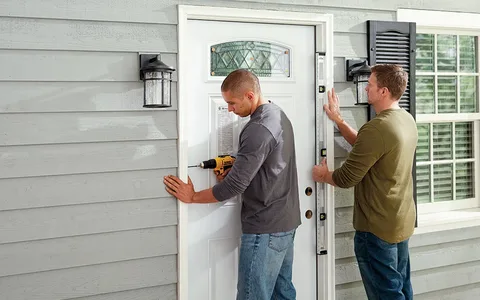
The exact process varies according to the project, but a professional replacement normally starts with an assessment of the existing opening.
Measurements need to be accurate before the new door is ordered or prepared.
The installation process may then involve:
- Assessing the existing door and frame
- Taking accurate measurements
- Selecting the appropriate door type and material
- Specifying suitable hardware
- Removing the existing door where necessary
- Repairing or replacing the frame if required
- Installing and aligning the new door
- Fitting locks, handles, hinges and other components
- Checking opening, closing and latching
- Completing final adjustments
Good installation is just as important as choosing a good-quality door.
Making Door Replacement Part of a Property Upgrade
Replacing doors can also form part of a wider refurbishment programme.
Landlords may replace bedroom and kitchen doors between tenancies. Homeowners may combine a new entrance door with redecorating the hallway. Businesses may update doors as part of an office refurbishment.
Thinking about doors as part of the wider project can make it easier to coordinate finishes, hardware and installation.
It also avoids situations where newly decorated walls or flooring are damaged because door work was left until the end.
Professional Door Replacement in London
London properties range from Victorian terraces and converted flats to modern apartment developments, offices, shops and HMOs.
That variety means there is no universal replacement door that works for every building.
Providers such as Liviosiv and Safety Spectrum London offer door replacement services covering front, internal, external and kitchen doors as well as specialist fire-rated applications.
The most appropriate replacement should ultimately be based on the condition of the existing opening, how the door is used and what the property owner wants to achieve.
Final Thoughts
A damaged door does not always need replacing, but repairs are not always the most economical answer either.
The decision should be based on the overall condition of the door, frame and hardware rather than a single visible defect.
For entrance doors, front door replacement can improve security, appearance and weather protection.
For kitchens, kitchen door replacement can refresh an outdated room without necessarily requiring a complete kitchen refit.
And when doors throughout a property have reached the end of their useful life, planned door replacement can provide a cleaner, more reliable and longer-lasting solution than continuing to repair the same problems repeatedly.